

When you see a student wearing a silver cord at graduation, you're looking at someone who has achieved something truly special. It's a distinct piece of academic regalia, but its meaning isn't universal—it changes from one school to another. While some institutions award it for top-tier grades, others reserve it for students with a deep commitment to community service.
What Does a Silver Graduation Cord Truly Represent
A silver graduation cord is so much more than just an accessory draped over a graduate’s gown. You can think of it as a wearable trophy. It’s a visible testament to the dedication, hard work, and achievement that went far beyond the standard coursework.
Its shimmering appearance on graduation day really makes the wearer stand out, signaling to everyone in the audience that this individual met a high standard set by their school. Unlike the cap and gown that every graduate wears, graduation honor cords like the silver one are earned. This is what gives them their real weight and significance. The meaning is decided entirely by the school, which fosters a unique sense of pride and community among those who receive it.
The Two Primary Paths to a Silver Cord
While the specific rules can differ quite a bit, the silver graduation cord generally symbolizes one of two major types of achievement: academic excellence or a profound commitment to community service.
- Academic Honors: Many colleges and universities use silver to recognize high academic standing. It often represents graduating magna cum laude, which typically requires a GPA in a specific high range, like 3.7 to 3.8.
- Community Service: In high schools, the silver cord is frequently awarded to students who have put in a massive amount of time volunteering. A common benchmark is completing 200 or more hours of service, proving the student's character and dedication to giving back.
This dual symbolism is pretty common across the United States. For example, it's not unusual for a high school program to award a silver cord for hitting that 200-hour volunteer mark. Meanwhile, at the university level, a school like Eastern New Mexico University uses it to honor graduates with a cumulative GPA associated with magna cum laude honors.
A silver graduation cord is a moment of public recognition. It visually separates students who have not only met the requirements to graduate but have significantly exceeded them in a specific, measurable way.
Below is a quick-reference table summarizing some of the most common reasons a student might be awarded a silver cord.
Common Meanings of a Silver Graduation Cord
| Achievement Type | Common Criteria | Typical Academic Level |
|---|---|---|
| High Academic Honors | Graduating magna cum laude (e.g., GPA 3.7-3.8) | University |
| Extensive Service | Completing 200+ hours of community service | High School |
| Leadership Roles | Holding a significant office in a student organization | University/High School |
| Specific Program | Excelling in a particular academic field or program | University/High School |
Ultimately, every cord color tells its own story. To get the full picture, exploring the various meanings behind graduation honor cords can clarify this rich academic tradition. These symbols, from silver cords to intricate graduation stoles, add deep layers of personal and institutional history to the whole commencement ceremony.
The Specific Requirements for Earning a Silver Cord
So, how does a student actually earn the right to wear a silver cord at graduation? It’s not just handed out; this distinction is based on very specific, measurable achievements. Schools set a high bar to make sure every cord draped over a graduate's shoulders represents some serious hard work and dedication.
The two most common paths to this honor boil down to academic excellence or a deep commitment to community service. For the book-smart crowd, it's all about hitting a precise Grade Point Average (GPA). For the community-minded, it's about logging a significant number of volunteer hours. These aren't just friendly suggestions—they're firm requirements you'll find spelled out in student handbooks.
This flowchart breaks down the two main avenues a student might take to earn a silver honor cord, showing how the focus can shift depending on whether they're in high school or university.

As you can see, high schools often tie the silver cord to community service efforts, while colleges and universities typically reserve it for top-tier academic honors.
Academic Excellence Benchmarks
At the university level, a silver cord is almost always linked to Latin honors, especially magna cum laude (great praise). While the exact number can differ from one school to another, this honor usually requires a cumulative GPA falling within a very high, narrow range, like 3.70 to 3.849.
Some schools might take a different approach, awarding it to students who finish in a certain top percentage of their class—say, the top 10% or 15%. These numbers are written right into the university’s rules to keep the standard for academic recognition consistently high. This is a pretty common system. For instance, Frostburg State University clearly defines the GPA bands for each level of Latin honors, linking specific honor cord colors to concrete achievements like a 3.650–3.899 GPA for magna cum laude. It's interesting to explore how cord colors correspond to specific university honors to see more real-world examples.
Community Service Milestones
In a lot of high schools, the silver cord is all about celebrating a student's selfless dedication to their community. The most common requirement? A massive, verifiable commitment to volunteer work.
The benchmark for a silver service cord is frequently set at 200 hours of documented community service completed over the course of a student's high school career.
And let’s be clear, this is no small feat. Hitting 200 hours means consistent effort, often juggling time between different non-profits, helping out at school-sponsored events, or working with local charities. Students usually have to keep detailed logs of their hours and get signatures from supervisors to prove their work was completed. It’s a process that truly highlights a student's character and their real-world impact, making that silver honor cord a powerful symbol sitting alongside their graduation stoles and other regalia.
Wearing Your Graduation Regalia with Pride
You’ve put in the years of hard work, and you've earned every single honor coming your way. Now, let’s make sure you show them off correctly on the big day. Properly wearing your silver cord isn't just about looking sharp in photos—it's about respecting the achievement it represents. A clean, polished presentation lets you walk across that stage with the confidence you deserve.
The idea is to create a look that’s distinguished, not cluttered. Your silver cord should hang neatly, complementing your gown and any other regalia you've earned, like a graduation sash or stole.

Draping Your Silver Cord Correctly
Putting on your silver honor cord is straightforward, but a few quick steps will guarantee it looks just right. Think of it as the final touch on an outfit you've spent your academic career earning.
- Find the Center: Hold the cord up and find its midpoint. Usually, this is marked by a small central knot that holds the strands together.
- Drape from the Back: Place that center knot at the back of your neck, so it rests comfortably under the collar or hood of your graduation gown.
- Ensure Even Length: Let the two sides of the cord fall naturally down the front of your gown. Take a second to adjust them so both tassels hang at the same height. This creates a clean, symmetrical look.
- Secure if Necessary: The weight of the cord and the fabric of your gown should keep it in place. For extra peace of mind, a small safety pin hidden under your collar can provide added security.
Following these simple steps ensures your silver cord graduation honor is displayed proudly and professionally.
Combining Cords with Graduation Stoles
Many high-achieving students wear more than one piece of regalia, often pairing a silver cord with a graduation stole or sash. The trick is layering them correctly for a polished, intentional appearance.
Your stole or sash should always be the base layer, lying flat against your gown.
Key Takeaway: Always put your graduation stole on first. After that, drape your honor cord over the top. This simple rule of thumb ensures the stole provides a smooth backdrop and prevents your cord from getting tangled or lost underneath.
Wearing multiple cords? The process is just as easy. Drape each one around your neck individually, allowing them to hang side-by-side. Gently arrange them so they lie as flat as possible against each other, creating neat, distinct lines down the front of your gown.
If you need a more detailed walkthrough, you can find great tips on how to properly wear honor cords for graduation in our full guide.
In the end, your regalia tells the story of your academic journey. By wearing each piece correctly—from the silver cord to the graduation sash—you present a complete and proud picture of your success.
Recognizing Dedication to Community Service
While a high GPA is a classic reason for academic honors, the silver cord often celebrates a different kind of achievement: a deep, personal commitment to community service. For many high schools, this honor cord isn't about test scores; it's a symbol of character, empathy, and giving back. It’s the school’s way of acknowledging students who invested countless hours of their own time to make their communities a better place.
This recognition is never handed out lightly. Earning a silver service cord requires a serious, verifiable commitment that goes far beyond the occasional weekend event. Think about it—dedicating the equivalent of five full-time work weeks to volunteering is the kind of effort we're talking about here. By setting the bar that high, schools make sure the silver cord remains a powerful symbol of true civic engagement.
The 200-Hour Benchmark for Service
To keep things fair and consistent, many high schools have put a number on that commitment. This creates a clear, structured goal for students to work toward.
- The Threshold: The most common requirement is hitting 200 hours of volunteer work over the course of a student's high school career.
- Verification Process: Students don't just say they did the work—they have to prove it. This usually means keeping detailed logs of their service activities, which must be signed off by a supervisor at each organization. It creates a clear paper trail of their contributions.
- Formal Recognition: Before the honor is awarded, the school administration carefully validates every single hour, making the silver cord a fully vetted achievement.
This 200-hour benchmark has become a widely accepted standard in American high schools. It also means that the recipients are part of a pretty exclusive group. Not every student has the time or drive to meet such a demanding requirement. For instance, one school report noted that only 14 students managed to earn the 200-hour silver cord, while an even smaller group of seven reached the 400-hour gold level. That really shows you how special this award is. You can read more about how these service programs are structured in school publications.
By framing community service with a clear goal, schools elevate volunteering from a simple extracurricular to a recognized achievement. The silver cord becomes a visible testament to a student’s compassion and work ethic, standing proudly alongside other academic regalia like custom graduation stoles.
Ultimately, this specific honor celebrates the very qualities that build strong communities. It’s for the students who balanced homework and exams with a genuine desire to give back, proving that a great education is about so much more than what happens in the classroom.
Choosing and Ordering Your Graduation Cords
Whether you're an administrator coordinating the entire commencement or a student picking out an honor cord, the small details matter. The quality of a graduation cord really adds to the polished look of the whole academic outfit, and getting it right ensures the final product truly honors the achievement it represents.
Making a good choice really boils down to knowing the standard physical features of an honor cord. These specs are pretty consistent across the board, which helps create that uniform, distinguished look on graduation day. When you're looking for a silver cord graduation honor, here are the key things to keep in mind.
Key Cord Specifications
Before you place an order, it helps to know what the industry standards are. A well-made honor cord isn’t just for looks—it’s a keepsake that will last for years.
- Standard Thickness: The vast majority of honor cords you'll see have a diameter of 1/4 inch. This gives them a nice, substantial feel without looking too bulky against a gown or stole.
- Typical Length: From end to end, most cords measure between 60 and 70 inches. This is the sweet spot that allows the cord to drape comfortably around your neck, letting the tassels hang evenly down the front.
- Durable Material: Rayon is the go-to material for graduation cords. It has a beautiful silky sheen that catches the light—much like silk—but with the added benefits of being more durable and wrinkle-resistant.
Following these specifications ensures the cord hangs just right and looks elegant all through the ceremony and in every photo. You can see these standards in action with our premium silver graduation honor cord, which is crafted to meet these exact requirements.
Understanding Styles and Customization
Beyond the basic specs, the style of the honor cord itself can say a lot. The design you choose often depends on the specific honor being recognized or the traditions of your school.
The style of a cord—whether single, double, or intertwined—often adds another layer of meaning. A multi-color cord, for example, might represent accomplishments in two different academic fields or membership in a specific honor society.
Picking the right graduation cord can feel overwhelming, but breaking it down by its features makes it much simpler. This comparison table outlines the common options to help you zero in on what you need.
Choosing Your Silver Graduation Cord
A comparison of common graduation cord styles and specifications to help you select the perfect one for your ceremony.
| Feature | Standard Specification | Considerations |
|---|---|---|
| Cord Style | Single, Double, Intertwined | A single cord offers a classic, clean look. Intertwined or double cords are often used to represent multiple honors or specific society memberships. |
| Tassel Size | Approximately 4 inches | The tassels should feel proportional to the cord itself, giving it a complete, finished appearance without being distracting. |
| Knot Style | Central knot or none | A small, decorative knot at the center back of the cord is a popular feature that helps keep it perfectly centered on your neck. |
Ultimately, whether you're an institution placing a bulk order or a student making a final selection, checking these details is key. For schools, it guarantees consistency across all graduates. For students, it's the final step to ensuring your hard-earned regalia is absolutely perfect for the big day.
Preserving Your Graduation Regalia as a Keepsake
Your graduation regalia isn't just an outfit you wear once. Think of it as a collection of tangible memories from one of the biggest achievements of your life. Preserving your silver cord graduation honor, gown, and stoles is the best way to keep those symbols of hard work and pride looking great for years to come.
Proper care starts the moment the ceremony ends.
It's a good idea to get your gown professionally cleaned or give it a gentle hand-wash to get rid of any wrinkles or dirt. Your honor cords and graduation stoles, on the other hand, are a bit simpler. They usually just need to be aired out and stored flat so they don't get snagged. Try to avoid folding them sharply, since that can leave permanent creases in the fabric or mess up the tassels.
Creating a Lasting Display
Turning your graduation gear into a permanent keepsake is a fantastic way to remember your academic journey. A shadow box is an elegant and popular way to do this.
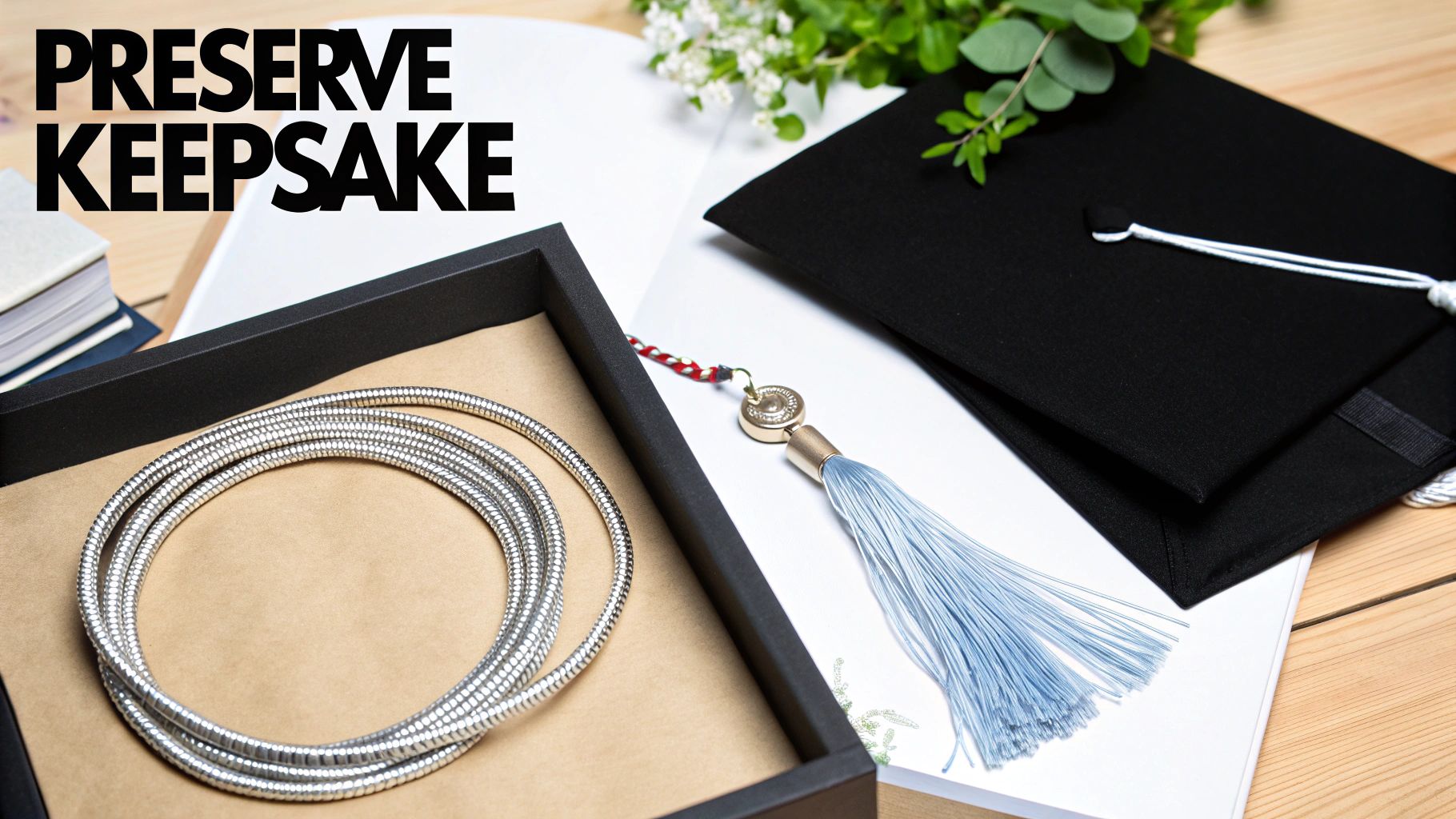
Here are a few tips to make it special:
- Arrange Items Creatively: Frame your silver cord next to your tassel, a favorite graduation photo, or even a small piece of your diploma.
- Protect from Fading: Use a display case that has UV-protective glass. You’ll also want to keep it out of direct sunlight to prevent the vibrant colors from fading over time.
- Add Other Mementos: Toss in smaller items to make the display feel more personal, like an honor society pin or even a piece of confetti you caught during the ceremony.
By treating your regalia as a cherished collection, you transform it from a one-time outfit into a lasting tribute to your academic success.
As you think about ways to mark this milestone, remember that many families also choose thoughtful personalized graduation gifts that can be treasured right alongside these keepsakes.
Common Questions About Silver Graduation Cords
As commencement gets closer, you're bound to have a few questions about your graduation regalia. When it comes to the silver graduation cord, knowing the rules ahead of time means you can wear your achievements with total confidence. Let's clear up some of the most common questions.
Navigating graduation day traditions can feel a little overwhelming, but we've got you covered. Whether you're curious about who gets a silver cord or trying to tell it apart from a gray one, getting the right info is key.
Can I Wear a Silver Cord My School Did Not Award?
The short answer is no. It’s highly recommended you only wear honor cords that were officially given to you by your school or a recognized honor society. Every piece of regalia, from graduation sashes to cords, is a symbol of a verified achievement. Wearing something you didn't earn can look like you're misrepresenting yourself on a day that’s all about celebrating genuine hard work.
Your best bet is to always check your school's official commencement guidelines first. If you belong to a national organization that awards a silver cord, you still need to confirm your school allows it to be worn at the ceremony.
What Is the Difference Between Silver and Gray Cords?
At first glance, they can look pretty similar, but silver and gray honor cords often represent completely different accomplishments. For instance, a bright, metallic silver cord might signify magna cum laude honors. On the other hand, a matte gray cord could represent a specific major, like veterinary science. It all comes down to your school's unique traditions.
The only way to know for sure is to consult your university's official regalia guide. This document will clarify the distinction and explain what each color represents within your specific academic community.
How Will I Know If I Earned a Silver Cord?
Don't worry, your school will let you know! You’ll get a formal notification if you've earned a silver cord. This message usually comes from the registrar's office, your academic advisor, or the department in charge of that specific honor, like the community service office.
The final calculations for eligibility often happen late in your final semester, once all your grades and volunteer hours are tallied. Students who qualify are typically notified through their student email or online portal, with instructions on how and where to pick up their honor cord before the big day.
Are Silver Cords Used for Graduate Degrees?
Yes, they absolutely are. Silver honor cords can be awarded at all academic levels, including for master's and doctoral degrees. The meaning, however, can shift a bit for graduate students. At this level, they are more often tied to specific academic honor societies, interdisciplinary university awards, or program-specific honors. This is a little different from the broad Latin honors (cum laude, etc.) that are more common for undergraduates.
At Stoles.com, we know that every piece of your graduation outfit tells a story of your hard work and success. Take a look at our collection of premium honor cords and graduation stoles to find the perfect symbols for your academic journey. Visit us at https://www.stoles.com to celebrate your achievements with pride.