

A graduate opens a regalia package at the kitchen table and lifts out a bright woven band. One parent sees a beautiful finishing touch. Another wonders whether it's a graduation stole, a sash, or something the school might not permit on stage. The student may be thinking about a different question altogether: how can this piece honor Mexican heritage without looking like a generic accessory?
A Mexican graduation sash can answer all three concerns when the family chooses carefully. It can reflect cultural identity, recognize a first-generation achievement, and coordinate with academic regalia. But the best choice depends on more than color. Fabric, motifs, embroidery, fit, school policy, and care all affect whether the sash feels meaningful and works smoothly during commencement.
What a Mexican Graduation Sash Actually Is
A student opens the regalia package and finds a bright woven band rather than a plain satin accessory. That piece is a Mexican graduation sash, a long decorated band worn over an academic gown. Its design may include Mexican flag colors, serape-inspired stripes, embroidered lettering, or motifs connected with Mexican heritage.
A serape-style sash is typically made from woven textile rather than smooth satin, and some are produced by artisans working on a loom in Mexico. Product descriptions for this format commonly describe two woven panels, each about 4 inches wide and 41 inches long, with fringe at both ends, as detailed by Sarape Sashes.
The terms can overlap, so the shape and purpose matter more than the label. A graduation stole usually hangs vertically from both shoulders over the front of the gown. Sash may describe a similar ceremonial band, while often highlighting cultural decoration or a crossing arrangement. An honor cord is thinner and rests around the neck, where it indicates academic achievement, membership, or service. A serape blanket belongs to clothing or household use, not fitted graduation regalia.
How the pieces sit
- Graduation gown: The outer robe covers the body and creates the formal academic silhouette.
- Mexican graduation sash or stole: The wider textile rests over the shoulders and hangs across the gown's front.
- Honor cord: The narrower cord sits above or beside the stole, depending on school instructions.
- Tassel: The cap accessory follows ceremony rules and does not replace cultural regalia.
Students wear Mexican graduation sashes at high school, college, and graduate-level ceremonies. Some choose a matching stole, tassel, or stole-and-cap set. Others wear one cultural piece beside an institution-approved honor stole.
The sash can carry personal and public meaning. It may represent family heritage, community belonging, bilingual identity, or the support that made graduation possible. A name, degree, organization, or community-service connection can add a second layer of recognition. A 2023 account described students wearing brightly colored Mexican stoles to represent cultural heritage while also signaling completion of 100 hours of community service through an academic organization, as reported by The 19th. Before ordering, families should also confirm that the school permits this type of cultural regalia on stage.
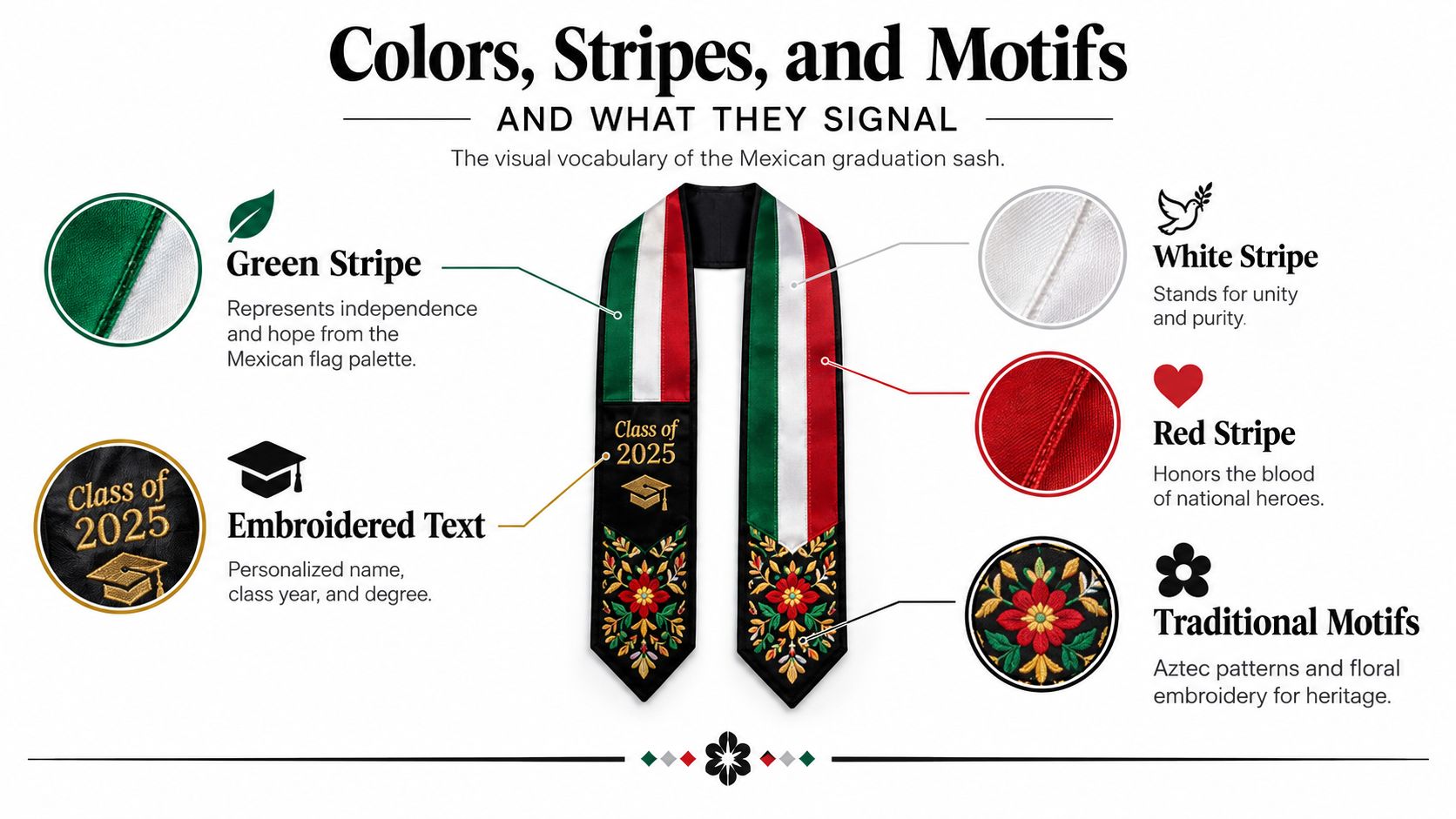
Colors, Stripes, and Motifs and What They Signal
Start with the visual element that people recognize fastest, the color palette. The Mexican flag uses green, white, and red, and families often choose those colors because they immediately communicate national and family connection on stage. Green can suggest independence and hope, white can suggest unity and purity, and red can honor the blood of national heroes. Those meanings are symbolic rather than a universal graduation code, so the student's family story should guide the final design.
A sash can use the palette in several ways. A narrow green, white, and red border looks restrained over a black gown. Broad color blocks create a stronger stage presence. A white sash with red and green embroidery feels quieter, while a red base with ivory lettering creates a sharper visual contrast in photographs.
Reading serape stripes
Serape-style stripes bring texture and movement to a graduation stole. Repeating horizontal bands can reference regional textile traditions associated with places such as Oaxaca, Saltillo, and Tlaxcala, although no single stripe arrangement represents every Mexican family or region. Bright, high-contrast stripes feel festive and visible from a distance. Muted earth tones create a more understated, formal impression.
Motifs also carry different levels of specificity:
- The eagle on a nopal cactus connects strongly with Mexican national imagery.
- Aztec calendar wheels create a bold historical reference and can dominate the entire face of a sash.
- Papel picado patterns add a lighter decorative rhythm, especially as a border.
- The Virgen de Guadalupe is a religious image, so it should be chosen because it has personal or family significance, not because it's recognizable.
- Floral embroidery can suggest regional craft traditions without making a specific national or religious claim.
Design rule: Choose one dominant message, then let the remaining details support it. A serape base with a small embroidered name usually reads more clearly than a flag, calendar wheel, religious image, degree, family name, and crest competing for the same space.
Before ordering, ask what the graduate wants viewers to understand first. Is the sash about Mexican nationality, a specific region, faith, family history, or a university organization? That answer will help separate an authentic cultural design from a generic product labeled “Mexican.”
The Cultural Roots Behind the Sash
A Mexican graduation sash doesn't come from one uninterrupted academic uniform tradition. Its modern form brings together indigenous textile knowledge, Mexican garments, university cultural ceremonies, and contemporary graduation customs.
The University of New Mexico's Raza Stoling Ceremony began in 1994, building on a student-support program founded in 1969, according to the University of New Mexico's account of the ceremony. That history matters because it shows how a stole can become part of a university's cultural recognition rather than functioning only as decoration. Northern Arizona University's 2023 Hispanic/Latine ceremony materials also explain that sarapes date to at least 1519 in Mexico and that woven garments could take months to make, giving the textile a depth that a printed pattern alone can't fully reproduce.
Earlier Mexican and Mesoamerican textiles provide useful context, but families should avoid treating every historical garment as a direct ancestor of today's graduation stole. The tilmatli, a rectangular cloth associated with elite status in pre-Hispanic societies, and the colonial rebozo belong to different settings and uses. Their relevance lies in the broader idea that woven cloth can carry identity, rank, belonging, and craft knowledge.
From textile tradition to commencement
The sarape's long, striped format translates naturally into a ceremonial band across a gown. Its visual impact comes from the combination of color, repetition, weave, and movement. A woven sash can therefore communicate more than “Mexican colors.” It can point toward family memory, regional craft, and the persistence of cultural expression in an institutional setting.
For families planning other major cultural celebrations, the same attention to symbolism can help when they plan a milestone quinceañera event. The event may be different, but the decision-making principle is similar. Clothing and ceremony should reflect the person being honored rather than rely on decoration without context.
The modern university setting adds another layer. Raza and Hispanic or Latino cultural ceremonies gave students a formal space to recognize heritage alongside academic achievement. A sash worn during a general commencement can carry that same dual message, especially when it includes a family name, campus organization, or degree.
For a closer look at related identity-based regalia, families can also review Hispanic graduation stoles. The important distinction is that “Hispanic,” “Latine,” “Mexican,” “Chicano,” and regional identities aren't interchangeable. A thoughtful design names or depicts the connection that belongs to the graduate.
How to Wear a Mexican Graduation Sash
Put the gown on first and zip it completely. If the school has approved an honor stole or honor cord, place that regalia according to the institution's instructions before adding the Mexican graduation sash. The cultural sash should be the final prominent textile layer, so its colors and embroidery remain visible instead of being buried underneath another stole.
Four practical positioning steps
- Set the shoulders. Place the sash over both shoulders. The center should form a natural V near the collarbone, not sit behind the neck or press tightly against it.
- Check the panels. Let both sides fall down the front of the gown. Many serape-style pieces have a deliberately uneven or asymmetrical cut that echoes the drape of a traditional textile. Don't trim or force the sides to match unless the maker specifically instructs you to do so.
- Cross the front. Cross the right panel over the left at the waist if that arrangement suits the design and ceremony instructions. Keep the stripes flat and in their intended sequence. Twisting the fabric can make embroidery unreadable and distort the pattern in photographs.
- Secure discreetly. Tuck the tip inside the gown or use a small safety pin from the inside, where it won't show. Keep the hem roughly 2 to 4 inches above the bottom edge of the gown so the sash remains readable without becoming a tripping hazard. The practical placement guidance is also covered in how to wear a graduation stole or sash.
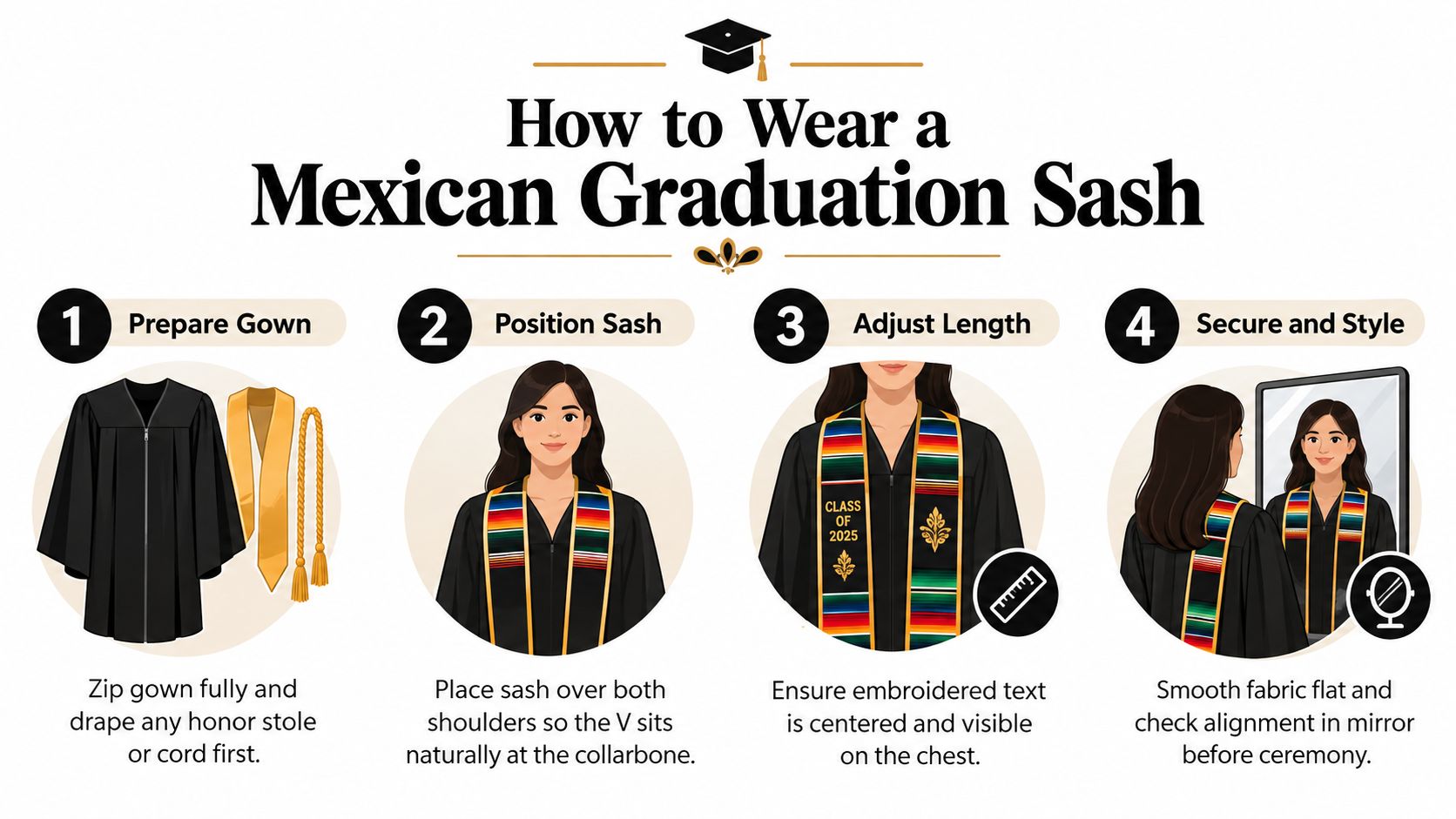
Stand in front of a mirror after pinning. The shoulders should look clean, the front panels should lie flat, and the name or degree should face outward. Take a test photograph from the distance a family member might use during the ceremony. Camera flash can reveal a misplaced pin or a fold that wasn't obvious in the mirror.
Avoid tying a knot, adding a belt, or wrapping the sash so tightly that it pulls the gown out of shape. If the graduate will walk, sit, shake hands, and pose for pictures, a secure but relaxed drape will look better than a complicated arrangement.
Customization, Embroidery, and Material Choices
The material sets the sash's visual character before any lettering is added. Satin has a smooth, bright surface, though it may slide against a gown. Polyester sateen offers a similar sheen with somewhat more grip. A lightweight wool blend feels heavier and more textile-like, but it can wrinkle during travel. Authentic serape-style construction uses woven panels and fringe, which can provide stronger drape definition than a cut-edge synthetic accessory.
Embroidery adds another layer of choice. A name and graduation year keep the message readable. Gold-thread institutional lettering creates a formal effect. A custom crest can combine a family name, campus symbol, degree, flag elements, or organization imagery, but each added detail uses space and can compete with the stripes.
| Material | Embroidery Style | Customization Depth | Typical Feel on Stage |
|---|---|---|---|
| Satin | Name, year, or short phrase | Basic to moderate | Smooth, bright, and formal |
| Polyester sateen | Contrasting lettering or border | Moderate | Light, polished, and easier to position |
| Lightweight wool blend | Traditional woven or embroidered detail | Moderate to extensive | Heavier, textured, and substantial |
| Serape-style woven textile | Stripes, fringe, and selective embroidery | Moderate to extensive | Textured, expressive, and visually distinctive |
Make the lettering work from a distance
Contrast often determines whether the message can be read during the ceremony. Ivory thread on a red field is easier to identify across the room than tonal thread on white. Tonal embroidery may suit a close portrait while disappearing in group photographs. Request a digital proof, then view the design at a reduced size before approving production.
Families coordinating a handmade or community-produced sash can buy variegated thread online from The Fabric Company. Choose thread colors that support the textile. A larger palette does not automatically make the design clearer, especially when the sash already contains strong stripes.
Compare customization tiers with four practical questions:
- What is stitched? Confirm whether the design is embroidered, printed, or woven into the textile.
- How dense is the stitching? Added detail can enrich the surface and increase weight.
- What backs the embroidery? A stable backing helps lettering hold its shape.
- When will it ship? The finished sash must arrive before the ceremony for a proof check and any needed correction.
For more help with lettering choices and layout, review this guide to graduation sash embroidery. A clear design gives the graduate one unmistakable focal point, whether that is a family name, degree, or carefully chosen symbol.
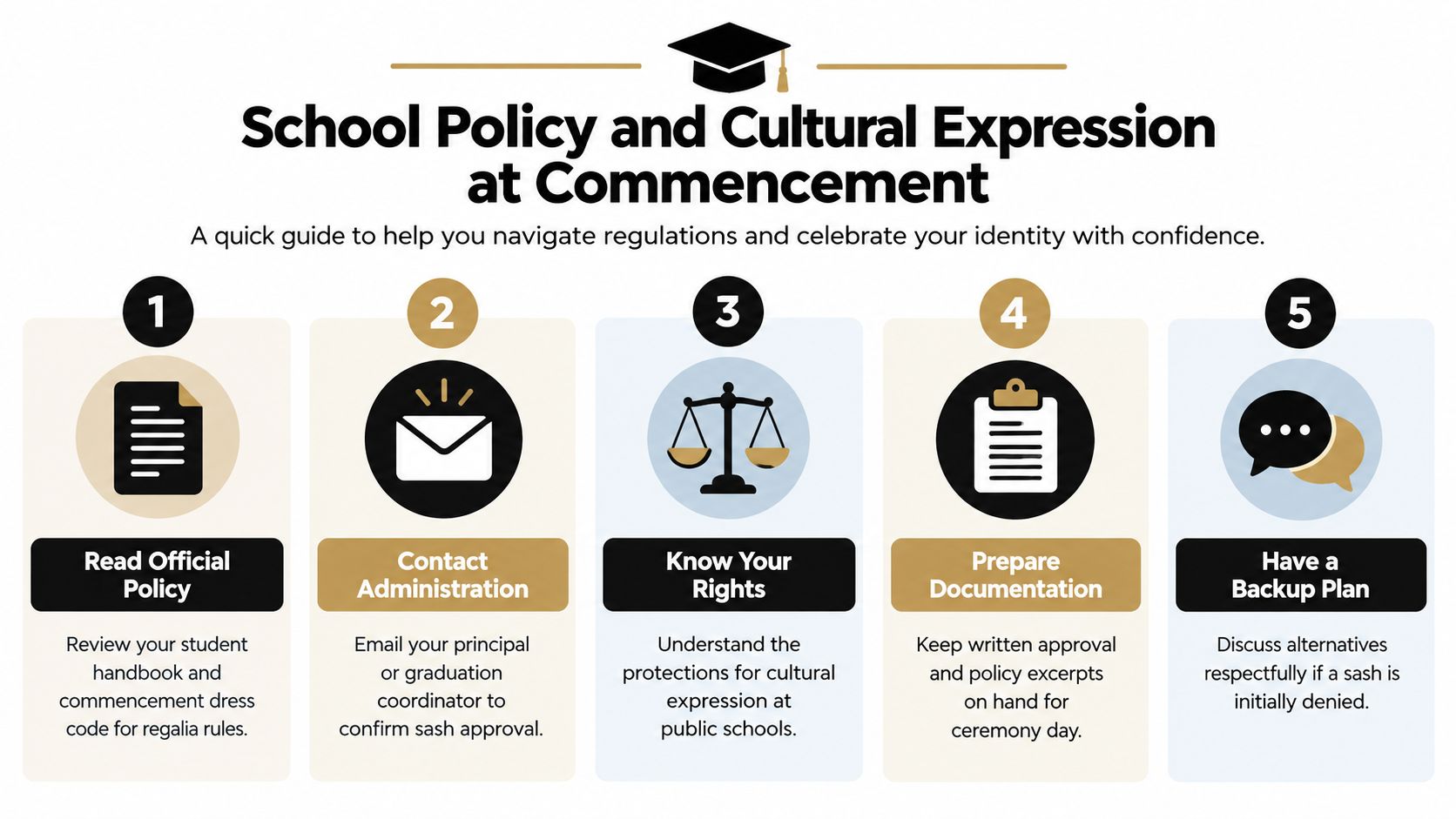
School Policy and Cultural Expression at Commencement
A culturally meaningful sash may feel obviously appropriate to a family and still raise a policy question for the school. Graduation regalia rules vary by institution. Some schools approve cultural stoles broadly, some limit colors or dimensions, and some permit only regalia supplied by the school or an affiliated organization.
The public debate became especially visible in a 2023 case involving a student whose Mexican and U.S. flag sash represented family heritage and first-generation achievement. A judge upheld the school's decision to block the sash at graduation, as reported by The New York Times. That case doesn't establish one rule for every school, but it does show why families shouldn't assume that cultural meaning guarantees permission.
Use a written process
Start with the commencement bulletin, student handbook, and dress-code language. Search specifically for sections covering academic regalia, cultural expression, accessories, colors, symbols, and non-school-issued items.
Then contact the registrar, graduation coordinator, student-affairs office, or principal in writing. Send the request early and describe the item precisely:
State the request clearly: Ask to wear a culturally significant Mexican graduation sash with its colors, family name, degree, or approved institutional emblem identified.
Keep the response and any approval in a folder, both digitally and on paper. A student who receives permission can carry the written approval on ceremony day in case a stage marshal questions the regalia.
Possible responses include:
- Full approval: The student may wear the sash as ordered.
- Limited approval: The school may approve the concept but require a certain length, color palette, or placement.
- Denial: Ask for the exact policy language and the reason the item falls outside it.
If the school denies the request, ask for a meeting with the dean, principal, or designated administrator. Families can also ask whether state-level cultural-expression protections apply, particularly at public schools. Don't rely on an argument made at the venue entrance. A calm written request, a precise description, and a documented response give the student a much stronger basis for discussion.
Care, Storage, and Ordering Timeline
Custom embroidery needs planning. A practical starting point is to place the order 6 to 8 weeks before graduation, then add a one-week shipping buffer for international orders from Mexican textile workshops, based on the ordering guidance supplied for this design process. Earlier ordering also gives the family time to inspect the sash, request corrections, and confirm that the final design matches the approved school request.
A printable preparation checklist
- 6 to 8 weeks before: Confirm the ceremony date, school regalia rules, sash dimensions, colors, wording, and embroidery proof.
- After approval: Save the school's written permission with the order confirmation.
- One week before expected delivery: Check tracking and prepare a backup plan if the package is delayed.
- Upon arrival: Inspect the stitching, fringe, colors, spelling, and placement while the item can still be corrected.
- Before the ceremony: Steam suitable satin or polyester lightly. Don't press the surface aggressively, because heat and direct pressure can create shine marks.
- The night before: Lay the sash flat or hang it in a cool, dry place away from direct sunlight. Pack pins, the written approval, and a garment-safe way to protect the piece.
- After the ceremony: Air-dry the sash flat if it has been exposed to moisture, then fold it with acid-free tissue.
Serape wool requires gentler treatment. Spot-clean it with cold water and mild detergent rather than saturating the entire textile. For embroidered surfaces, press from the reverse side through a cloth instead of placing an iron directly over the thread.
Protect the sash on ceremony day
Keep hairspray, perfume, and cosmetics away from the textile because they can affect dyes or leave marks. If a spill occurs, blot rather than rub. Pin from inside the gown to reduce visible damage and prevent the sash from slipping during the procession.
After graduation, choose a keepsake method based on the family's space and time:
- Shadow box with the tassel: The most display-oriented option, but it requires careful mounting and suitable wall space.
- Canvas with a diploma photograph: A personalized presentation that takes more design preparation.
- Digital archive: Photograph the sash flat and in use, then store the images with the graduate's ceremony records. It requires the least physical effort and preserves the design for family sharing.
A breathable cotton bag is safer for long-term storage than plastic, which can trap moisture. Fold the sash loosely, support fringe so it doesn't become crushed, and keep it away from heat, sunlight, and damp storage areas.
Stoles.com® offers customizable graduation stoles, including Mexico flag, serape-style, mixed USA and Mexico, honor, and custom options for students and organizations. Visit Stoles.com® to compare a Mexican graduation sash or cultural stole with the graduate's school policy, preferred symbolism, and embroidery needs.