

Graduation day is right around the corner, and making sure your honor cords and graduation stoles look just right is one of those final, important details. The standard way to wear graduation honor cords is actually quite simple: find the center knot of the cord, place it behind your neck, and just let the tassels drape over your shoulders. They should hang evenly down the front of your gown. This keeps everything symmetrical and really showcases your academic achievements.
Your Quick Guide to Wearing Graduation Honor Cords
Commencement is full of traditions, and every piece of your regalia—from the cap on your head to the graduation stole draped over your shoulders—has its place. Honor cords are special; they're the vibrant symbols of all your hard work and success in different honor societies or fields of study. Wearing them the right way is a small sign of respect for everything you've accomplished. It might seem like a minor detail, but getting the placement right completes your look and helps you feel confident for the ceremony.

The method is pretty much universal: draped around the neck with the tassels hanging in front. This ensures everyone can see the cords that symbolize what you've earned. It’s a practice recognized globally, highlighting the shared value of celebrating academic excellence. If you're curious, you can learn more about the professional meaning of graduation cords to appreciate the history behind them.
Honor Cord Draping At a Glance
To make it even easier, here’s a quick-glance table for getting your regalia just right. A few simple tips can help you avoid any last-minute fumbling and make sure every piece, from your graduation sash to your cords, is perfectly placed.
| Regalia Type | Key Placement Tip | Common Mistake to Avoid |
|---|---|---|
| Single Honor Cord | Center the middle knot at the nape of your neck, making sure both tassels hang at equal lengths in the front. | Letting one tassel hang noticeably lower than the other, which can look unbalanced in photos. |
| Multiple Honor Cords | Group the cords, find the center of the bundle, and drape them together as one unit to keep them from tangling. | Placing them on one by one. This usually leads to a messy, cluttered look as they shift around. |
| Cords with a Stole | The graduation stole always goes on first. Drape your honor cords right over the top of it. | Putting cords on under the stole. This hides your honors and makes the stole bunch up awkwardly. |
Knowing these basics helps a ton, whether you have a single cord for Latin honors or several from different societies. The goal is to create a clean, organized display of your achievements that you can wear with pride through the whole ceremony.
What Your Honor Cords Really Mean
Before you get caught up in figuring out how to wear your graduation honor cords, it’s worth taking a moment to appreciate the tradition they come from. These aren't just colorful ropes to throw over your gown; they’re powerful symbols of your hard work, late nights, and the unique academic path you carved out for yourself. Every honor cord and graduation sash draped over your shoulders tells a piece of your story.
While academic regalia has roots going back centuries, the specific tradition of honor cords is a bit more recent. It really took off in the 1920s when universities started looking for ways to visually recognize students who excelled or were part of prestigious honor societies. By the 1950s, more than 70% of American colleges had adopted some version of the honor cord or stole, a practice that’s stronger than ever today. You can get a feel for the deep history of academic regalia at universities like LSU.
University Honors vs. Departmental Cords
It helps to know that not all cords come from the same place. Your university will award specific cords, usually for achieving Latin honors based on your final GPA. These are often the classic gold or silver cords and represent broad academic excellence.
You'll see them for distinctions like:
- Cum Laude (with praise)
- Magna Cum Laude (with great praise)
- Summa Cum Laude (with highest praise)
Think of these as the university’s official nod to your overall high standing.
Then you have the cords that come from specific honor societies, academic departments, or even student groups. These get much more personal and recognize achievements in a particular area. For instance, a dentistry student might earn a lilac cord, while a pharmacy grad could wear an olive green one, showcasing their success in a specialized field.
Wearing your honor cords isn’t just about following a dress code. It’s a chance to celebrate your personal story and the specific milestones that got you to graduation day.
The Personal Story of Each Cord
Think of each cord as a chapter in your college story. That shiny gold cord? It speaks to your consistent high grades. That blue and white cord from your honor society? It shows your leadership and dedication to your major. It’s not uncommon to see a student wearing multiple cords that paint a full picture of their time at school.
For example, an education major might walk the stage wearing a light blue cord from their department, a gold cord for their GPA, and a multi-colored cord from the Kappa Delta Pi honor society.
This layering of graduation stoles and honor cords is what makes commencement so visually impressive. It’s a celebration of all the different passions and paths that brought every student to that same stage. By browsing our premium collection of Graduation Honor Cords, you can find the perfect way to represent every single one of your hard-earned achievements. Understanding the "why" behind each cord makes wearing it that much more meaningful.
A Practical Guide to Draping Your Honor Cords
Alright, you've earned the honors, now let's make sure they look perfect on the big day. Getting your honor cords to sit just right is pretty straightforward, but a few insider tips can make all the difference between a polished look and a tangled mess. Your hard-earned achievements deserve to be displayed flawlessly.
For graduates with a single cord, the key is symmetry. Start by finding the center of the cord—you'll usually find a small knot right in the middle. Place that knot at the back of your neck, right on the nape.
Let the two tassels fall forward over your shoulders. A quick check in the mirror is all it takes to ensure they're hanging at equal lengths down the front of your gown. Simple as that.
Mastering Multiple Cords
Wearing multiple cords? That’s fantastic! The main challenge here is keeping them looking neat and organized, not like a jumble of ropes. The trick is to group them before you put them on.
Don't drape them one by one. Instead, lay all your cords on a flat surface and arrange them in the order you want them displayed. Once they're stacked nicely, pick up the whole bundle as one unit. Find the center point of all the knots combined and drape the entire group over your neck. This little move keeps them lying flat and looking sharp.
The tradition of wearing honor cords has come a long way, evolving from a specialized custom to a worldwide symbol of academic dedication.

As you can see, what started in the 1920s became widely adopted by the 1950s, and today, it's a globally recognized sign of scholastic success.
Securing Your Regalia for the Big Day
Commencement ceremonies can be long. You’ll be walking, standing, and maybe even dealing with a breeze at an outdoor venue. The last thing you need is to be constantly fidgeting with your regalia.
This is where a small safety pin becomes your best friend. After you’ve draped your cords perfectly, just reach under the back of your gown and pin the central knot (or knots) to the fabric near the zipper. It's a discreet trick that anchors everything in place, so you can focus on your moment without any wardrobe worries. It’s especially helpful if your cords are heavy or the ceremony is outside.
Pro Tip: If you're wearing both a graduation stole and cords, always put the stole on first. Let it lie flat against your shoulders and gown, then drape your honor cords over the top.
This layering method makes sure every piece of your academic regalia is visible. Each honor you've earned is significant, and proper placement ensures none of them are accidentally hidden. To get the full picture, you can learn more by checking out our guide on understanding graduation hood colors and their meanings, which adds even more context to these cherished traditions.
Coordinating Cords with Stoles and Sashes
It’s pretty common for graduates to earn multiple accolades, which means you might be wearing more than just honor cords on the big day. When you also have graduation stoles, sashes, or medallions in the mix, knowing the proper order of operations is key to looking sharp and feeling comfortable.
The secret is layering everything correctly so each honor is visible and has its moment.
As a firm rule of thumb, your graduation stole or sash always goes on first. It should be draped evenly over your shoulders so it lies flat against your gown. Think of this as the foundation for the rest of your academic regalia.
Once your stole is sitting perfectly, you'll drape your honor cords directly over it. This layering hierarchy is intentional—it ensures the wider stole doesn’t bury the cords, and the cords don't cause the stole to bunch up awkwardly around your neck.
Arranging Your Regalia for a Polished Look
If you have a few different cords to place over a wide stole, they can sometimes slide around. To keep everything in place, try gathering your cords into a single, neat bundle before you place them over your neck. This simple trick helps them stay put on top of the stole’s fabric.
For graduates with even more honors, like medallions, there's a specific place for them, too. Here’s the established order from the gown up:
- Medallions: These are usually worn on a ribbon and should be placed around your neck before anything else. They rest directly against your gown, sitting underneath all your stoles and cords.
- Stoles/Sashes: This is your next layer. It sits over the medallion ribbon and directly on your gown.
- Honor Cords: These are the final touch, draped neatly right on top of your stole or sash.
This order of operations is designed for both presentation and comfort. Following it prevents your regalia from looking cluttered and ensures every single one of your achievements gets the spotlight it deserves. Many universities, like Montclair State, are specific about wearing only approved regalia, which really reinforces the importance of a coordinated appearance.
The goal is to create a distinguished, not disorganized, look. Proper layering ensures each piece of your regalia complements the others, showcasing a complete picture of your academic journey.
Practical Tips for a Cohesive Style
Just imagine a graduate with a beautiful, wide, satin Kente stole. If they were to put their honor cords on first, the stole would completely cover them up. But by placing the stole on first and then draping a gold cord for Summa Cum Laude over it, both items are perfectly visible and celebrated.
Ultimately, coordinating these pieces is all about honoring each achievement equally. Taking a moment to layer everything correctly will make a huge difference in your photos and your comfort throughout the ceremony.
For a deeper dive into the first and most foundational step, be sure to read our helpful article on how to wear your graduation stole and sash.
Decoding Honor Cord Colors and Meanings
When you look out across a sea of graduates, the rainbow of honor cords draped over their gowns tells a story. Each color represents a unique passion, a specific achievement, or a commitment to a particular group. It’s a visual language that adds a wonderful layer of meaning to the whole ceremony.
While a gold cord is almost universally recognized as the symbol for high academic honors like magna cum laude, many other colors signify a graduate’s dedication to their field of study or membership in a prestigious honor society.
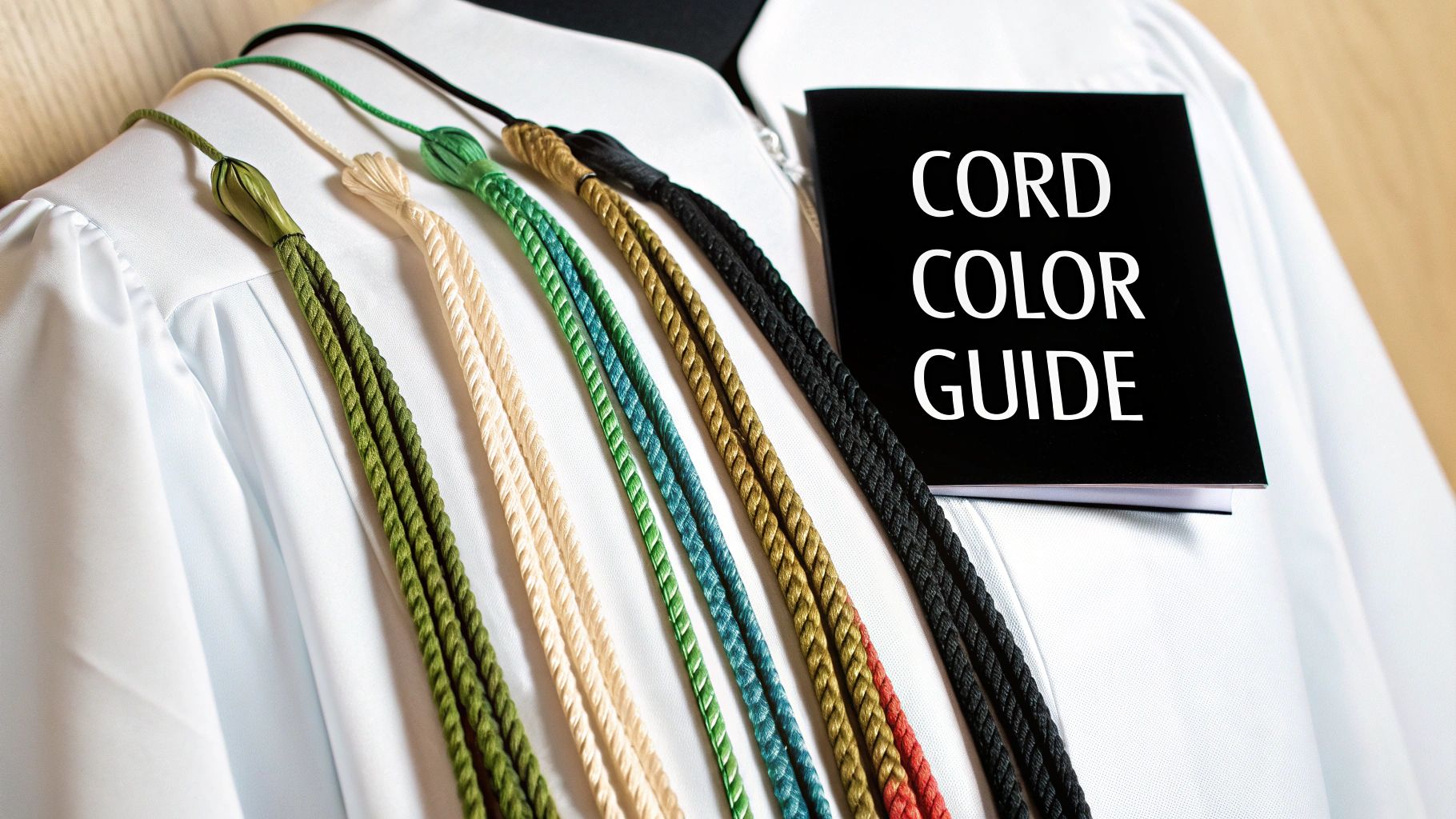
This tradition of assigning meaning to colors is a long-standing practice in academia. Think of it as a visual shorthand that lets family, friends, and faculty instantly recognize where a graduate focused their energy. For example, a student wearing a light blue cord likely spent their time in the education department, while someone with a lilac cord excelled in dentistry.
Common Colors and Their Academic Fields
While individual schools might have their own unique customs, the American Council on Education (ACE) has helped standardize many of these color associations. This creates a generally consistent code you’ll see at universities across the country.
Here are a few widely accepted color meanings you'll likely spot at commencement:
- Light Blue: Represents the field of Education, honoring future teachers and administrators.
- Olive Green: Symbolizes accomplishments in Pharmacy and the pharmaceutical sciences.
- Lilac: Denotes a degree in Dentistry, a highly specialized field.
- Drab (Tan/Brown): This color is associated with Business, Commerce, and Accounting.
- White: Signifies achievements in the Arts, Letters, and Humanities.
This is just a small sample, of course. For a more complete list, you can read our comprehensive guide on graduation honor cord color meanings.
Colors for National Honor Societies
Beyond your major, national honor societies use their own distinct color combinations to identify their members. In 2021, the Association of College Honor Societies found that a whopping 65% of honor societies use cords for recognition—with over 500 societies issuing their own unique color schemes. You can discover more about honor societies and their regalia on Wikipedia.
The sheer variety of colors is a testament to the specialized knowledge and dedication within academic communities. Seeing a graduate with cords from both their university and an honor society paints a much fuller picture of their scholastic journey.
These cords represent a serious commitment to excellence within a specific discipline. For instance, a member of the National Business Honor Society might wear hunter green and silver cords to showcase their business prowess. Likewise, a graduate from the Science National Honor Society would be distinguished by their green and purple cords. These unique combinations are a true badge of honor.
Common Questions About Wearing Graduation Cords
Even after you've got the basics down, a few last-minute questions about your honor cords can pop up. That's completely normal—you want every detail of your big day to be just right. Let's walk through some of the most common ones so you can feel confident and ready for the ceremony.
One of the first questions we often hear is, "Can I wear my high school honor cords at my college graduation?"
The short answer is almost always no. Your college commencement is all about celebrating the achievements you earned at that institution. While your high school accomplishments are a huge deal, university regalia policies are typically pretty strict, limiting you to honors earned during your college career. When in doubt, a quick check of your school's official graduation guidelines will give you a definitive answer.
Navigating Specific Scenarios
Another common worry is purely practical: How do you keep your honor cords from slipping off your shoulders, especially if you're facing a long ceremony or a windy day outdoors?
Your best defense is a good offense—start with proper draping. Make sure that central knot is perfectly balanced right at the nape of your neck, as this does most of the work. For a little extra insurance, a small, discreet safety pin is your best friend. Just pin the cords to your gown from the inside, near the back of the zipper. It'll be completely invisible but will keep everything securely in place, letting you focus on the moment, not your regalia.
A quick tip: Many graduates wonder if certain cords belong on the left or right side. Don't sweat this one—there's no rule! Honor cords are designed to be worn symmetrically, with the tassels hanging evenly on both sides for a balanced, polished look.
Finally, what do you do with your cords once the ceremony is over? These aren't just accessories; they're tangible symbols of years of hard work and dedication.
Many graduates create a shadow box to display their diploma, tassel, and cords together—a beautiful, all-in-one tribute to their journey. Another great idea is to simply drape them over the corner of your framed diploma. This turns your academic regalia into a meaningful piece of decor that you can appreciate for years to come.
At Stoles.com®, we believe every achievement deserves to be celebrated with distinction. Explore our collection of premium graduation stoles and honor cords to find the perfect way to showcase your success on your special day.