

So, what does it really take to become the valedictorian? It's more than just getting good grades. Much more.
The core high school valedictorian requirements boil down to a few key things: nailing the highest weighted GPA, loading up on the most demanding courses your school has (think AP or IB), and being relentlessly consistent from day one. A perfect 4.0 unweighted GPA is a great start, but it's often not enough. When everyone has straight A's, schools look at the difficulty of your classes as the ultimate tiebreaker.
What It Really Takes to Become Valedictorian

Grabbing that top spot is an endurance race, not a sprint. It kicks off the moment you walk in as a freshman and requires a strategic mindset for every single class you pick. While the specific rules can vary a bit from one high school to another, the mission is always the same: prove you are the undisputed academic champion of your entire graduating class.
This isn't just about avoiding a few B's. It's about proactively chasing the toughest curriculum available. A lot of students can pull off a 4.0 GPA, but only a tiny fraction can do it with a schedule packed to the gills with Advanced Placement (AP), International Baccalaureate (IB), or advanced honors courses.
Those challenging classes are your secret weapon. They’re the key to unlocking a weighted GPA that can climb well above a 4.0, giving you the edge you need to clinch the valedictorian title.
The Core Pillars of a Valedictorian Campaign
Your journey to becoming valedictorian rests on three crucial pillars. You can't just be good at one or two—you have to dominate all three to even have a shot.
- Highest Weighted GPA: This is it. The single most important number. Schools use a weighted system to give extra credit for taking harder classes. An A in an AP Chemistry class might be worth 5.0 points, while an A in a standard-level class is a 4.0. This simple math is how a student with a few B's in college-level courses can leapfrog someone with straight A's in easier ones.
- Maximum Course Rigor: You have to prove that you never took the easy way out. That means signing up for the highest-level science, math, history, and English courses your school offers, year after year. Guidance counselors and principals absolutely notice when a student maxes out their AP or IB options.
- Unyielding Consistency: This is a marathon. One "off" semester during your freshman year can be enough to take you out of the running in a competitive school. Every single report card, every midterm, and every final exam adds up to create your cumulative GPA. There's no room for error.
To give you a clearer picture, here’s a quick checklist of what schools are really looking for.
Core Valedictorian Requirement Checklist
This table breaks down the primary factors that determine who gets the top spot. Think of it as your game plan for the next four years.
| Requirement Area | Key Focus | Why It Matters Most |
|---|---|---|
| Weighted GPA | Earning a GPA above 4.0 | This is the clearest, most objective measure of academic dominance. |
| Course Rigor | AP, IB, and Honors Classes | Shows you actively pursued the greatest academic challenge possible. |
| Academic Consistency | Strong Grades Every Semester | Proves you can sustain high-level performance over a long period. |
| Class Rank | Being #1 or in the Top 1% | The ultimate goal; your GPA and course rigor directly determine this. |
Ultimately, understanding these foundational high school valedictorian requirements right from the start gives you a massive advantage. Your goal isn't just to be a straight-A student; it's to be the straight-A student who also took on the toughest academic mountain and conquered it.
For any aspiring valedictorian, the unofficial motto should be simple: "If there is a harder version of a class, take it." This is the mindset that separates the top student from all the other high-achievers.
Maximizing Your GPA for a Competitive Edge
Your Grade Point Average is the single most important factor in the race for valedictorian. Getting good grades seems simple enough, but maximizing your GPA requires a whole lot more than just studying for exams. It’s a strategic game, and it all starts with understanding the math that powers your class rank.
Most high schools calculate rank using two different GPAs: weighted and unweighted. Your unweighted GPA is the straightforward one—it runs on a standard 4.0 scale. An A is a 4.0, a B is a 3.0, and so on, no matter how hard the class is.
But the real competition? That happens with the weighted GPA.
The Power of a Weighted GPA
A weighted GPA is where the magic happens for top students. It gives more mathematical "weight" to the grades you earn in advanced courses. So, while an A in a standard-level English class is a 4.0, that same A in an Advanced Placement (AP) or International Baccalaureate (IB) class could be worth a 5.0.
This one detail is what separates the contenders from the rest of the pack.
Think about it this way: two students have straight A's.
- Student A took all standard-level courses. Their unweighted GPA is a perfect 4.0.
- Student B took five AP courses and also aced them. Their weighted GPA could easily be a 4.5 or higher.
Even with identical report cards, Student B is going to rank higher every single time. This is why you can't afford to take the easy road. Loading your schedule with the most rigorous courses your school offers isn't just about showing colleges you can handle a challenge; it's about playing the school's own grading game to win.
The goal isn't just to get a perfect 4.0. It's to push your weighted GPA as far above 4.0 as you possibly can. That mathematical buffer is what will secure your spot at the top.
Building a GPA-Focused Strategy
Nailing the highest GPA isn't about having one amazing year. It’s a marathon that requires four years of consistent, strategic choices. Every grade, starting from your very first day as a freshman, gets factored into your final cumulative GPA. There's no warm-up period.
Let's say a student gets a B in AP Calculus during junior year. It might feel like a huge setback, but if they have a long track record of A's in other weighted courses, their overall GPA can absorb the hit. The impact of one lower grade gets diluted when it's surrounded by years of excellence. Consistency is your best defense against that one unexpectedly tough class.
Here are a few tactics to protect and grow that GPA:
- Go for Rigor Early: Don't wait until junior year. Take the honors or advanced versions of your core classes as a freshman and sophomore to start building a strong weighted GPA foundation from day one.
- Play to Your Strengths (But Don't Ignore Weaknesses): Load up on AP/IB courses in subjects you naturally excel in. At the same time, don't shy away from challenging classes in areas that are tougher for you. A balanced, rigorous transcript is far more impressive than being a one-trick pony.
- Never Settle for a B: The moment you feel yourself slipping, get help. Immediately. Go to your teacher's office hours, find a tutor, or organize a study group. An early intervention can absolutely turn a potential B into an A, saving your weighted score.
At the end of the day, maximizing your GPA is a numbers game. Once you understand how weighted grades work and commit to relentless consistency, you can build an academic record that meets even the most demanding high school valedictorian requirements.
Building a Valedictorian-Worthy Course Schedule
The grades you earn are only half the battle. The classes you choose? That's what truly sets you apart.
Crafting your four-year course schedule is like drawing the blueprint for your academic career. It needs to shout ambition, intellectual curiosity, and a willingness to tackle the toughest challenges your high school has to offer.
A common trap is thinking a string of easy A's is the quickest path to the top. The truth is, selection committees will almost always favor a student with a 4.0 in a schedule packed with AP or IB courses over one with the same GPA in standard-level classes. It shows you didn’t just take the easy road—you actively sought out the most rigorous path. That’s an unwritten but critical rule in the valedictorian race.
Prioritizing Rigor Over Comfort
First things first: you need to identify every single advanced, honors, AP, or IB course available at your school. Walk into your guidance counselor's office with a clear mission: to map out a four-year plan that includes the most demanding classes in every core subject—math, science, English, and history.
This isn't about dodging subjects you find difficult; it’s about leaning into them.
- Freshman & Sophomore Years: Your goal here is to take the honors versions of all your foundational courses. This does two crucial things: it prepares you for the beast that is AP/IB curriculum and starts building your weighted GPA early on.
- Junior & Senior Years: This is crunch time. Your schedule should be loaded with your school’s most advanced offerings. If your high school has AP Physics C, AP Calculus BC, and AP English Literature, your transcript should reflect that level of ambition.
This infographic breaks down the strategic timeline for building a GPA that can truly compete for the top spot.
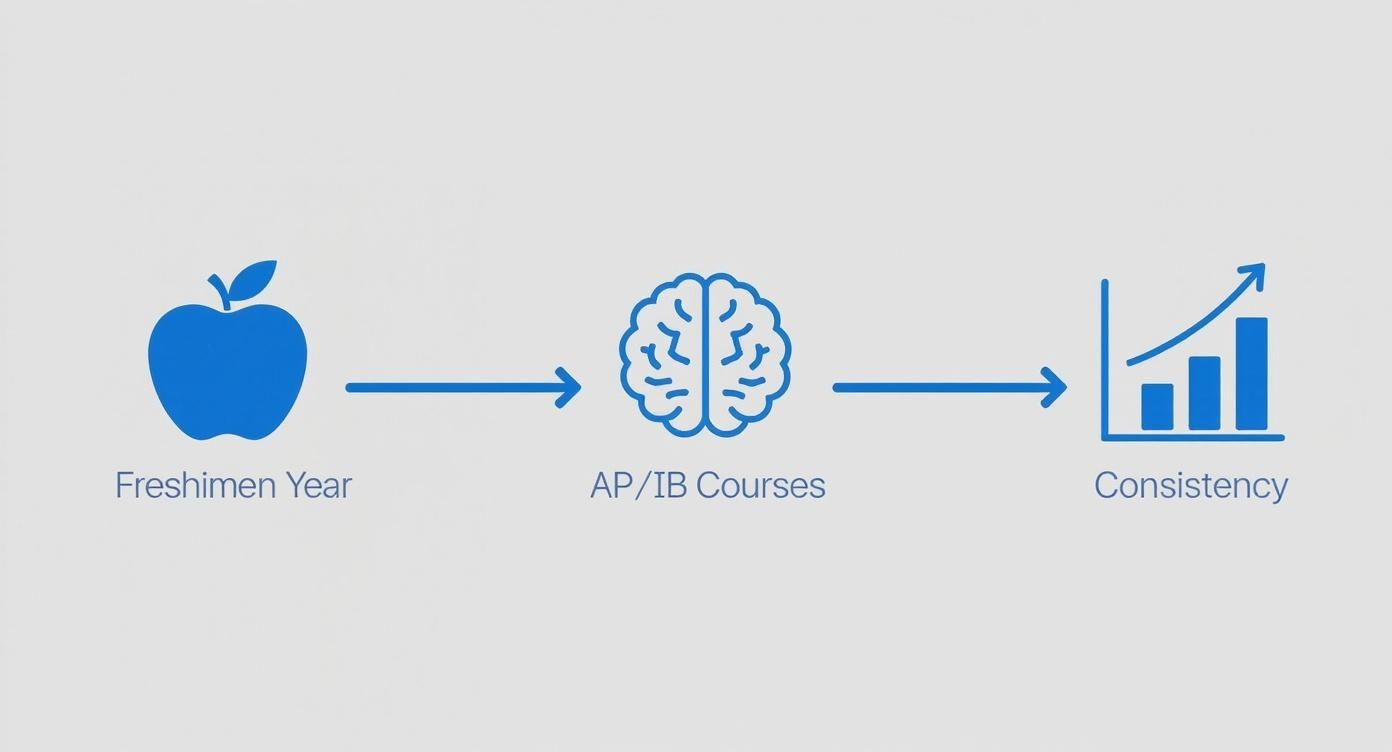
As you can see, a successful campaign for valedictorian is built layer by layer. You start with a strong foundation and then intensify with advanced coursework over time. It’s a marathon, not a sprint.
Balancing Ambition with Reality
While maximizing rigor is the goal, burning out is a very real risk. The key is to strike a strategic balance.
Don’t overload yourself with five AP classes in a single semester if it means your grades are going to slip across the board. It is far better to earn solid A's in four AP courses than to limp by with B's in five.
The strongest valedictorian candidates don't just take hard classes—they excel in them. Your transcript should tell a story of consistent excellence under pressure, not a story of being overwhelmed.
Think about the global standard for academic excellence. In countries like South Korea, which has a staggering 99% high school graduation rate, the entire educational system is built on intense rigor and sky-high expectations. This culture of achievement mirrors the mindset needed to compete for valedictorian in the U.S. Simply meeting graduation requirements won’t cut it. If you want to dive deeper, you can find more insights on international graduation standards over at WorldAtlas.com.
Ultimately, your course schedule is your primary evidence. It's the proof that you didn't just meet the high school valedictorian requirements—you actively sought out the most challenging academic environment possible and thrived in it.
Navigating Your School’s Unique Rules and Policies
Thinking every high school picks its valedictorian the same way is a rookie mistake. The truth is, the specific high school valedictorian requirements can be wildly different from one district—or even one school—to the next. You have to become an expert on your school’s unique policies.
Fortunately, that information is usually hiding in plain sight: your student handbook.
This document is your roadmap. It should detail the exact calculation for weighted GPAs, which courses are eligible for honors credit, and any weird residency rules, like needing to be enrolled for a minimum number of semesters. Trying to win this race without knowing the rules is a surefire way to get tripped up.
Becoming an Expert on Local Policies
Your guidance counselor is your single most valuable resource in this journey. Don't just wander in; schedule a meeting and come with a clear agenda. Your mission is to walk out of that office with zero ambiguity about how the valedictorian is chosen.
Show up prepared with a list of sharp, targeted questions:
- Does our school name just one valedictorian, or do you use a tiered system like summa cum laude?
- Is the final decision based only on the highest weighted GPA, or are there tie-breakers?
- Are courses taken outside of school—like at a community college or online—factored into the GPA for class rank?
- Has the school ever talked about getting rid of the valedictorian title altogether?
Getting the answers to these questions early is a game-changer. Some schools have already ditched the single-valedictorian model to ease academic pressure, choosing instead to honor a group of top scholars. Knowing this on day one could save you from chasing a title that might not even exist by the time you graduate.
Don’t assume the policies are set in stone. School boards can, and do, change graduation requirements and academic honors policies. Keep an eye on school board meeting minutes and district-wide announcements to stay ahead of any shifts.
How State Standards Influence Your School
Local school policies don't exist in a vacuum. They're often built on the foundation of broader state-level graduation standards. These state requirements dictate the baseline number of credits and the types of courses every student needs to earn a diploma.
For instance, the recent U.S. average high school graduation rate was 87%, a figure that reflects all sorts of state-level policies. The National Center for Education Statistics has a ton of data on how these rates are calculated across the country.
When a state updates its core curriculum or testing mandates, local districts almost always have to adjust their own academic policies in response. This can ripple down and change how class rank is calculated or which courses get a GPA boost. This is exactly why knowing your school’s rules inside and out is so important—it helps you adapt if the game changes mid-play. You can learn more in our guide to navigating high school graduation requirements.
The Unspoken Rules of Character and Involvement

So, what happens when two or three students have virtually identical GPAs, all packed with the toughest courses the school offers? How does anyone make the final call? While your transcript is the star witness in your case for valedictorian, it’s not always the only voice in the room.
This is where the unspoken rules of character, reputation, and meaningful involvement come into play. Think of them as the ultimate tiebreaker. It’s not about just padding your resume with a long list of clubs you barely showed up for. This is about showing who you are beyond the report card.
It’s about genuine intellectual curiosity and being a positive force in the school community. A student known for asking insightful questions, truly collaborating on group projects, and helping their peers is building a reputation that precedes them. Remember, faculty members talk. When the time comes to discuss academic honors, their perception of you as a student and person can absolutely influence the conversation.
Beyond the Classroom Walls
Meaningful participation in extracurriculars is a fantastic way to showcase your character. But the key word here is meaningful. One or two long-term commitments where you really dig in and take on a leadership role will always be more impressive than a dozen superficial memberships.
Let’s look at a couple of real-world examples:
- The Science Whiz: This student doesn't just ace AP Physics; they're also the captain of the Science Olympiad team. This shows a passion for the subject that goes far beyond just getting a good grade.
- The Community Organizer: Another top student might pour their energy into leading a major community service project, demonstrating real initiative and a commitment to helping others.
In both of these scenarios, the students are proving they are more than just a GPA. They are active, contributing members of their community. This deep involvement builds a compelling story about who you are, making you a far more memorable and well-rounded candidate for the school's top honor.
The goal is always depth over breadth. Your extracurriculars should tell a story of commitment and growth, not a story of someone just trying to check off boxes for a college application.
The Power of Strong Faculty Relationships
Your teachers and counselors are more than just instructors—they are your advocates. One of the smartest things you can do in high school is build respectful, professional relationships with them.
This is simple stuff, really. Participate in class. Ask for help when you need it. Show genuine interest in what you're learning.
When a selection committee is split, the vocal support of a few respected teachers who can speak to your work ethic, curiosity, and positive attitude can be the deciding factor. Your academic record shows what you achieved; your character and relationships show how you achieved it.
As you get closer to graduation, it's also a good idea to understand the symbolism behind the honors you've earned. This includes knowing the specific meanings of the graduation honor cords and stoles you might be wearing on the big day.
Your Top Valedictorian Questions, Answered
Navigating the path to valedictorian can feel like you're trying to solve a puzzle with no instructions. It's totally normal to have a ton of questions. Let's break down some of the most common ones that students and parents ask when they're aiming for that top spot.
Is a Perfect 4.0 GPA Enough to Be Valedictorian?
Honestly? It's usually not. In most competitive high schools today, a perfect unweighted 4.0 GPA is more of a starting point than the finish line.
The valedictorian title almost always goes to the student with the highest weighted GPA. This is a crucial distinction. The weighted scale is designed to reward you for taking on tougher classes.
Think of it this way: a student with straight A's in standard-level classes will almost certainly be outranked by a student who also gets straight A's but took a schedule packed with Advanced Placement (AP) or International Baccalaureate (IB) courses. Those advanced classes are often graded on a 5.0 scale, pushing a weighted GPA well beyond a simple 4.0. The winner is the one who marries perfect grades with the most challenging curriculum available.
When Does the Race for Valedictorian Really Begin?
It kicks off the minute you walk through the doors as a freshman. Seriously. There's no "practice round" in high school; every single grade you earn in a course that gives you credit counts toward your final, cumulative GPA. Your performance in 9th grade is just as important as your junior year.
The students who successfully become valedictorian understand that it's a four-year marathon, not a final-year sprint. They build elite study habits from day one and aim for top marks from the get-go, knowing that one bad semester can be incredibly difficult to recover from.
This long-term mindset is non-negotiable because schools use your entire high school transcript to calculate the final class ranking.
Can I Still Be Valedictorian If I Transfer Schools?
This is a tricky one. The answer depends entirely on your new school district’s policy, which is why you need to ask about it the moment you enroll.
Some high schools have what’s called a residency requirement. This rule might state that a student has to be enrolled for a minimum amount of time—say, the final four or even six semesters—to be eligible for the title.
Other schools have complicated ways of blending GPAs from previous institutions. This can sometimes put transfer students at a disadvantage if the old and new schools have different grading scales or course weights. If you're a transfer student with your eyes on the prize, your very first stop should be the guidance counselor's office to get a clear, official answer on your school's specific rules.
Do Online or Summer School Courses Count?
This varies a lot from school to school. Some districts might not weigh external courses—like those you take online or at a community college over the summer—the same as classes taken on campus with their own teachers.
These courses might count toward your graduation credit requirements, but they could be completely left out of the GPA calculation that determines class rank.
Before you sign up for any outside course, get written confirmation from your counselor about how it will affect your official GPA and class standing. This one simple step can save you from a huge misstep in your academic strategy. In the same vein, understanding all the ways your school recognizes achievement is part of the process; you can learn more about how schools celebrate accomplishments by reading about who can wear a graduation stole.
At Stoles.com, we believe every academic achievement deserves to be celebrated. Find the perfect honor stole to showcase your hard work and dedication on graduation day by visiting us at https://www.stoles.com.