

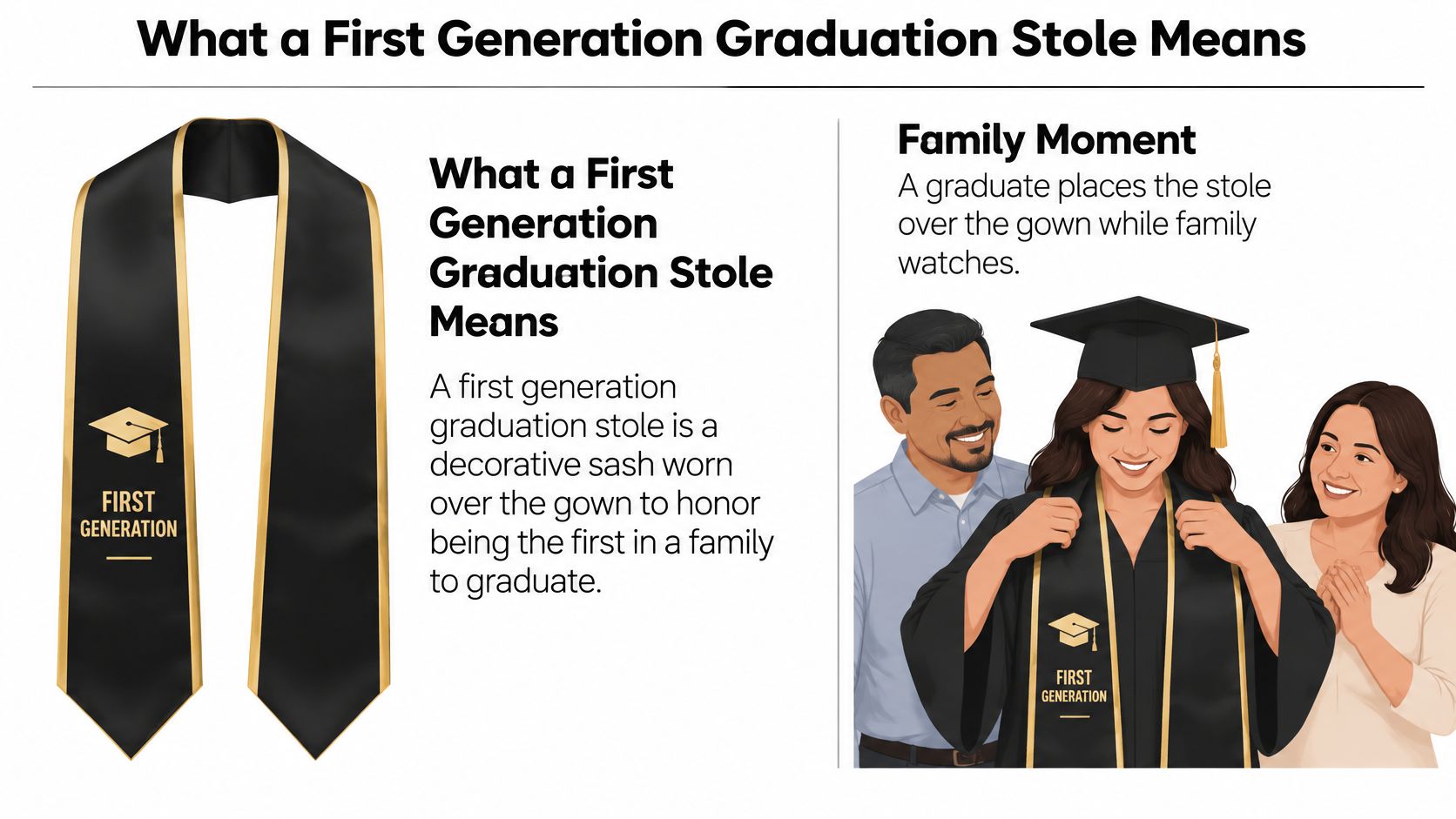
A first generation graduation stole is a decorative sash worn over the gown that publicly identifies the wearer as the first in their family to earn a college degree, marking an intergenerational milestone rather than decorating an outfit.
You may already have your cap and gown ordered, while your family is asking which sash to buy and whether you're allowed to wear it. Those are reasonable questions. The right choice depends on your university's eligibility definition, ceremony rules, and the story you want your stole to tell.
What a First Generation Graduation Stole Means
A graduate settles a satin sash over their shoulders while a parent straightens the ends. A grandparent steps back to look, and someone reaches for a camera. Before anyone walks across the stage, the family has a moment to recognize what this degree means.
The garment belongs to academic regalia, the clothing and accessories worn for graduation. A graduation sash is another term you'll encounter for a stole. Its first-generation wording makes an otherwise personal family milestone visible to the people gathered for commencement.
Why the milestone carries weight
A first-generation college graduate generally means someone who has completed at least a bachelor's degree while neither parent completed one. Among adults ages 22–59, 26% whose parents lacked a bachelor's degree had earned one themselves, compared with 70% who had a college-educated parent, according to Pew Research Center's analysis of first-generation graduates.
That same analysis reported that, in 2019, households headed by first-generation graduates had median annual income of $99,600, compared with $135,800 for households headed by continuing-generation graduates. Median household wealth was $152,000 versus $244,500, respectively. These figures describe groups, not any graduate's future, and they shouldn't be treated as promises of financial success.
Continuing-generation describes graduates with at least one college-educated parent. The comparison helps explain the significance of crossing an educational boundary, without suggesting that a parent's education determines a child's ability or ambition.
The illustration below connects the garment with the family moment it can represent.
Recognition without comparison
Your stole doesn't need to explain every challenge you faced. You might wear it to honor a parent who encouraged you, a sibling who helped at home, or your own persistence through unfamiliar academic systems.
Being first-generation recognizes an educational milestone. It isn't a judgment about the value of anyone else's work or life experience.
For families helping a younger student prepare for the same journey, first-gen college planning with Mrs. College Counselor offers a place to begin that conversation. Your graduation can be both a celebration of what you've completed and an invitation for someone else to consider what comes next.
First Generation Stole Design Ideas and Symbols
Start your design with the message you most want people to notice. If that message is First-Gen Graduate, make those words the focal point rather than surrounding them with so many details that they disappear.
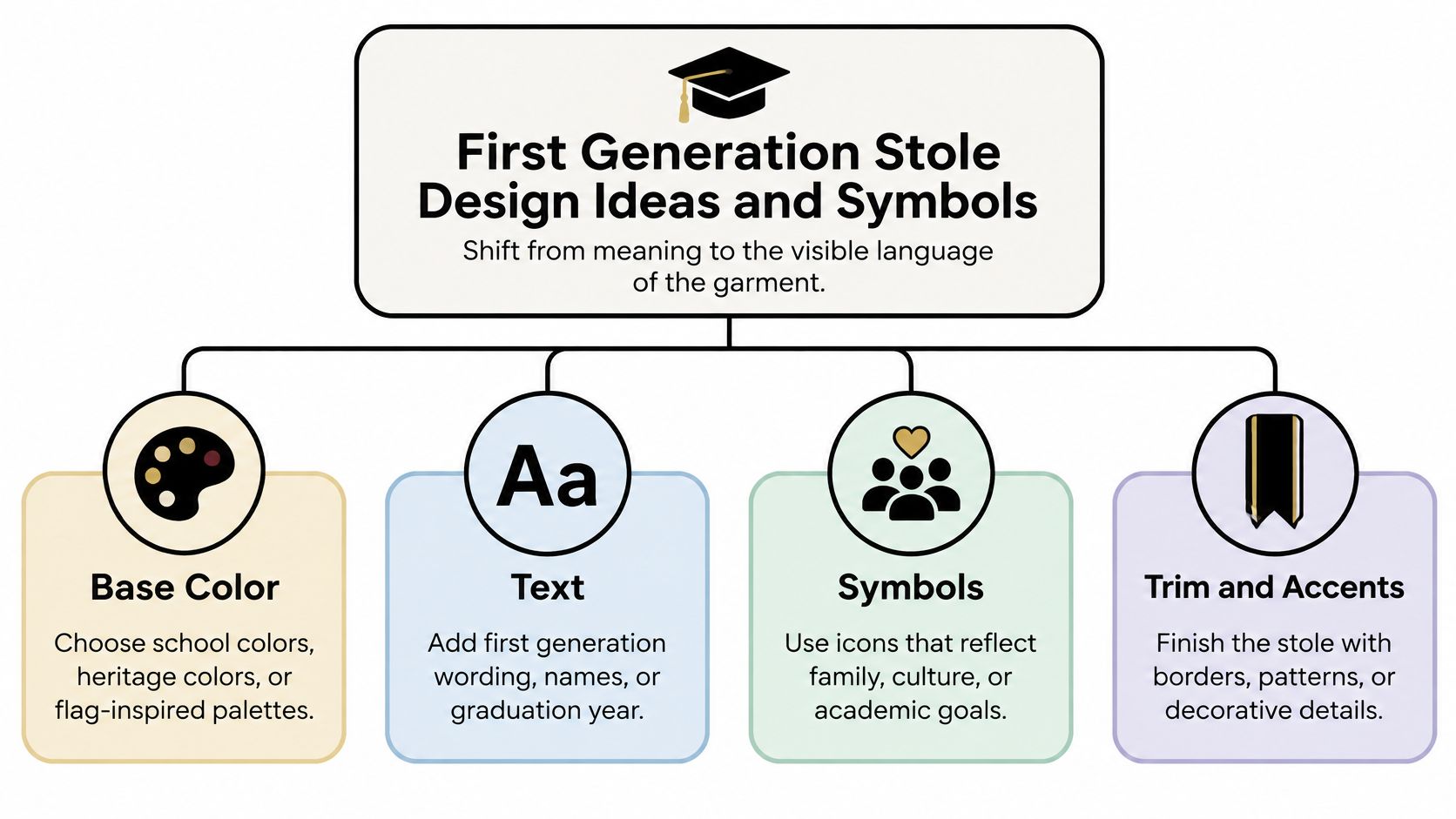
This design map can help you separate the main choices before combining them.
Choose a color and a clear message
Your base color is the main fabric color. School colors can connect the stole to your campus, while heritage colors or a flag-inspired palette can recognize your family's roots. Don't assume a color has the same official meaning at every university.
Choose wording you'll still feel comfortable displaying after graduation. A family surname, graduation year, or short message of perseverance can make a personalized graduation stole meaningful without making it crowded.
- Lead with identity. Place the first-generation wording where it won't be hidden by your hands or other approved accessories.
- Add a dedication. A surname or brief family message can recognize the people who supported you.
- Use symbols selectively. A flag, campus emblem, or program mark should have a clear reason for being there. Ask permission before using institutional artwork.
- Leave breathing room. Blank fabric around lettering helps the message stand apart from borders and decorative details.
For example, consider a school-color sash with first-generation wording on one panel and your surname and class year on the other. A small flag near the lower edge could add cultural meaning without competing with the main text.
Decide how the design will be applied
Embroidery creates lettering or artwork with stitched thread. Printing applies the design to the fabric's surface. When comparing embroidered stoles with custom printed stoles, ask the producer which method suits your lettering, artwork, and preferred finish.
Embroidery is worth considering when you want raised, textured lettering. Printing may suit artwork that depends on detailed color changes. Ask to see an example rather than assuming every production method will reproduce your design equally well.
A trim is a decorative finish along an edge. A contrasting border can frame a simple design; a patterned border can become a major visual feature. If you choose an elaborate border, keep the lettering restrained.
Use the accompanying video as another visual reference while considering your layout.
Before approving anything, view the design at roughly its intended size. Ask whether a family member could identify the main message without leaning in to read it.
Checking Your Eligibility for First Gen Regalia
Your university's definition controls eligibility for its recognition program. A general definition online can help you understand the term, but it can't settle every family situation or authorize you to wear particular regalia.
Montana State University's guidance centers eligibility on parents or guardians not completing a four-year degree, while UC Irvine uses a similar parent-or-guardian definition. Montana State also publishes blue and silver for its first-generation regalia, illustrating why students should consult their institution's graduation regalia guidance rather than assume a universal standard.
Ask about your actual family circumstances
An associate degree is a different credential from a bachelor's degree. A rule focused on bachelor's completion therefore asks a different question from whether a parent ever attended college.
Other situations require more than a quick yes-or-no form. If grandparents raised you, ask whose educational history the program considers. If a parent earned a degree outside the country, ask whether the university counts that qualification.
A parent who finished a degree after you enrolled creates another timing question: does the institution assess status at entry, at graduation, or under another rule? Describe the circumstances to the first-generation program, registrar, or commencement office instead of guessing.
A useful question to send: “Could you confirm whether I qualify under your first-generation definition, given my parent or guardian's educational history?”
For broader questions about who may wear different types of sashes, the guide to whether anyone can wear a graduation stole provides additional context. Keep program eligibility separate from permission to wear a purchased accessory.
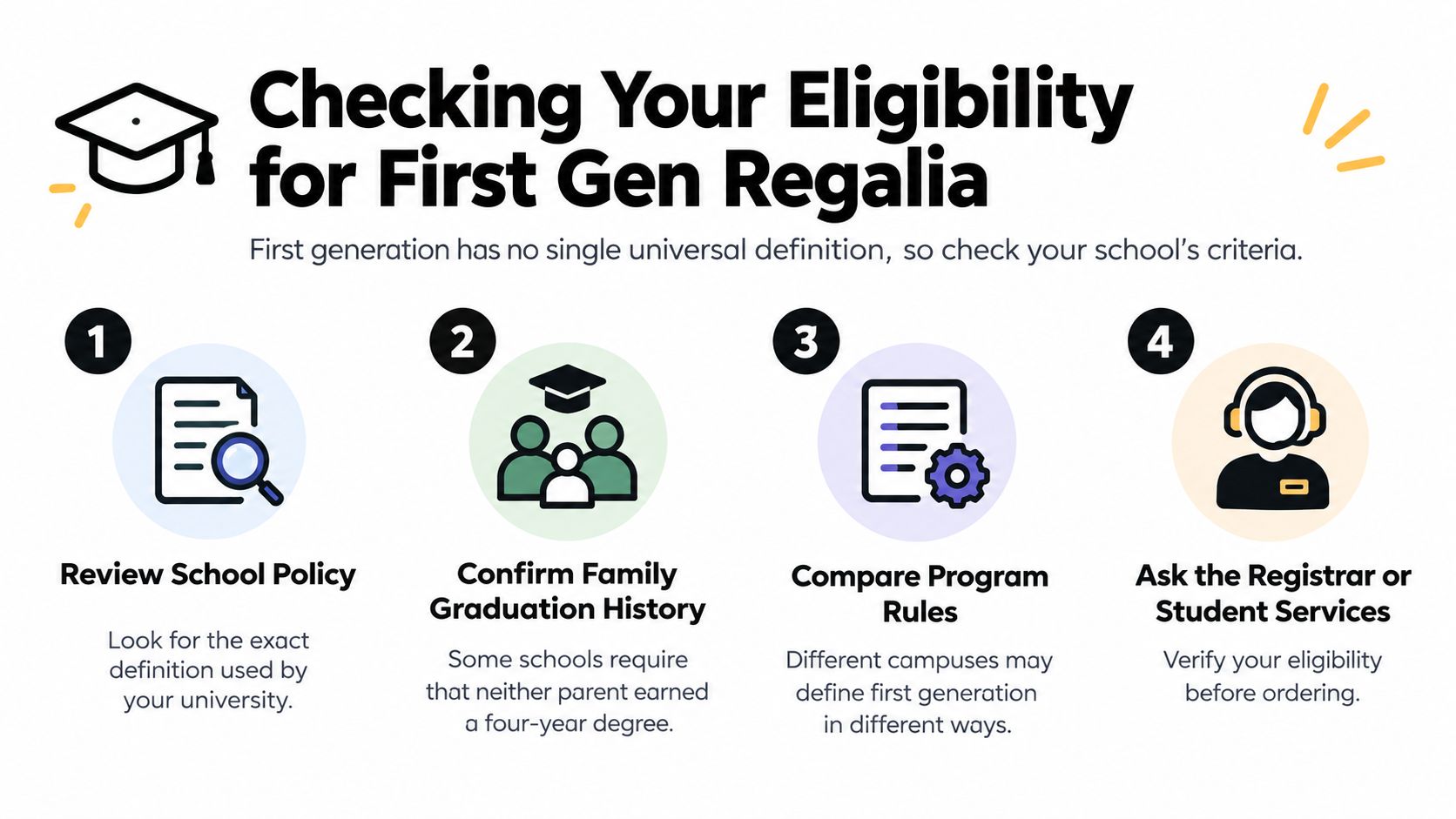
The checklist below highlights the information to gather before ordering.
Verify the practical details
Recognition isn't supplied in the same way everywhere. Some institutions give eligible graduates a stole; others expect a purchase or use an approved organization to distribute it.
- Find the exact definition. Save the current eligibility language and the office's answer to any unusual circumstances.
- Confirm how you receive it. Ask whether the stole is supplied, purchased, or available through a separate recognition event.
- Check documentation requirements. Find out whether self-identification is sufficient or whether an application or verification is required.
- Record the deadlines. Confirm application, ordering, and pickup dates, including whether someone else may collect it for you.
There's nothing embarrassing about asking these questions. Getting a written answer protects you from spending money on the wrong item.
Commencement Rules for Stoles and Honor Cords
Qualifying for first-generation recognition and receiving permission to wear a particular stole are separate matters. Commencement is the graduation ceremony, and its organizers decide which accessories may accompany the official gown.
Stacking means wearing multiple accessories together. A first-generation sash, cultural stole, religious accessory, military recognition, and organization stole may all matter to a graduate, but personal importance doesn't automatically create permission to combine them.
How Universities Handle First Generation and Personal Regalia
| Institution | Personal or Student-Selected Stoles | Approval and Stacking Rules |
|---|---|---|
| University of Southern Indiana | Allows an approved student-selected stole or cord | Permits one alongside university-provided items; new designs require approval at least 60 days before commencement, under its stoles and cords policy. |
| Tennessee Technological University | Prohibits personal individual stoles | Requires official regalia or specifically approved exceptions under its commencement regalia guidelines. |
| Assumption University | Permits respectful, appropriate personal or purchased adornments | Accessories must not diminish or obscure official academic regalia, according to its commencement regalia policy. |
| University of Memphis | Permits academic honor cords and stoles at official academic events | Assigns cords to defined academic and service categories through its cord and stole policy. |
These differences matter when choosing between an international flag stole, a fraternity or sorority stole, and first-generation recognition. If your ceremony restricts student-selected accessories, ask whether an approved combined design is possible or whether separate recognition-event photographs would be more appropriate.
A stole isn't automatically an honor cord
An honor cord is a rope-like accessory, typically finished with tassels, that a university or recognized organization may assign to a particular achievement. A stole's first-generation message doesn't automatically authorize an academic honor.
At Memphis, the policy cited above identifies undergraduate academic cords for GPAs from 3.25 to 4.0, recognized academic honor societies, and military service. Its colors distinguish white for distinction, crimson for high distinction, and gold for highest distinction. Those meanings belong to that institution's system, not to every graduation ceremony.
Policy-first rule: Buying an accessory doesn't establish eligibility for the honor or permission to wear it.
Before purchasing, save the ceremony's written policy and ask whether university-issued items take precedence. Confirm the number of permitted accessories, whether alterations are allowed, and who approves a new design.
Don't rely on a previous graduate's photographs as proof of current permission. A written response from the responsible office is a firmer basis for ordering and arranging your outfit.
Customizing and Ordering Your Graduation Stole
A good order begins with a settled design, not an approaching deadline. Gather your approved wording, color choices, artwork permissions, and ceremony requirements before contacting a producer.
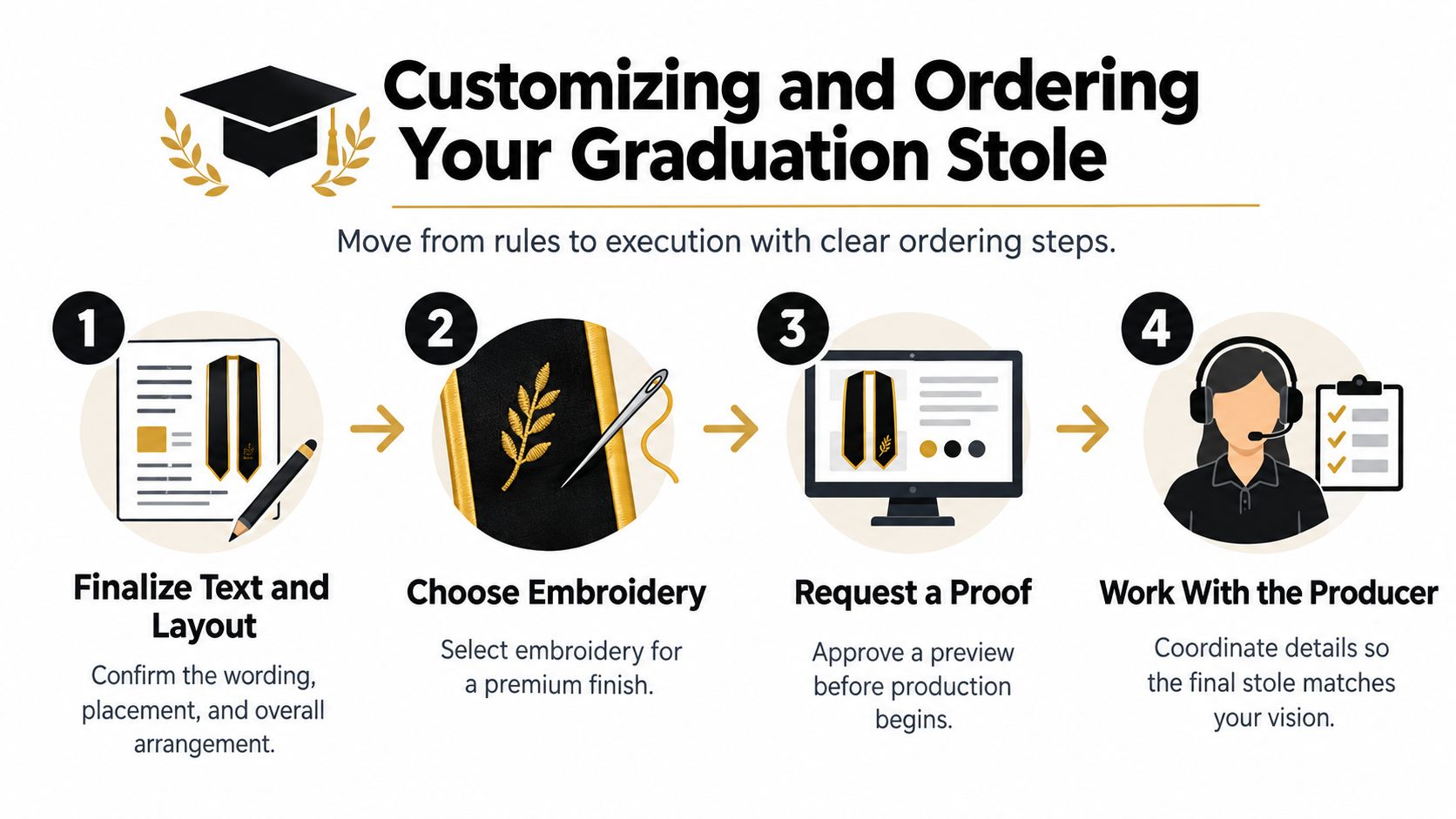
The ordering sequence below keeps design review separate from production.
Review the proof before production
A proof is a preview showing how the finished design is intended to look. Request one and check the actual spelling, punctuation, graduation year, placement, and artwork, rather than approving only the overall impression.
For an embroidered first-generation stole, ask whether small lettering or detailed symbols need simplification. If you prefer a premium-looking stitched finish, discuss thread contrast and the appearance of the lettering with the producer.
- Finalize the layout. Identify which design belongs on each hanging panel and which direction the text should face.
- Check the details aloud. Read names and wording while comparing them with your original order.
- Confirm the schedule. Work backward from the ceremony, allowing for institutional review, production, shipping, and a chance to inspect the delivery.
- Keep the approved version. Save the proof and written order confirmation together.
The custom graduation stole guide can help you prepare the details for a customization conversation. Ask the supplier for its actual timeline rather than relying on a generic online estimate.
Match the category to the wearer
A custom graduation stole suits personal names, dates, and original wording. An international flag stole emphasizes national or family heritage, while a Greek stole displays fraternity or sorority affiliation. Honor stoles and graduation honor cords should reflect recognition you're authorized to claim.
Families can compare a university-issued option, an approved campus supplier, and a specialist customization retailer. The appropriate choice is the one that meets the ceremony's rules and accurately represents the graduate.
For institutional buyers, keep identity, participation, and academic achievement distinct. UCF's model combines first-generation identification and graduating-senior eligibility with four professional-development events for first-generation regalia, while its separate cord adds a 3.5 cumulative GPA threshold. Other campus programs, such as the University of Texas at Austin's first-generation graduation program, offer a separate institutional reference for planning recognition and distribution.
An organization should publish its criteria before collecting orders. Maintain a recipient list, explain pickup arrangements, and distinguish a first-generation award from an academic honor so students understand exactly what they're receiving.
How to Wear a First Generation Graduation Stole
Lay out only the accessories approved for your ceremony. Put on and fasten your gown first so you can see how the stole sits against the finished outfit, rather than trying to adjust everything at once.
An academic hood is the shaped fabric worn with certain degrees. If you have one, follow your university's dressing instructions and ask a marshal or commencement assistant to check its position.
Use a mirror to center the fabric
Hold the stole by its middle and place that midpoint behind your neck. Let the ends fall down the front of the gown, then adjust the fabric across your shoulders until the panels hang evenly.
- Flatten the neckline. Smooth the fabric behind your neck so it isn't folded into a narrow ridge.
- Compare the ends. If one hangs lower, move the stole at the neck rather than repeatedly pulling the bottom.
- Check the message. Turn each panel outward so the lettering faces the audience and camera.
- Protect official insignia. Keep required gown details, the hood, and other institutional identifiers visible.
For another dressing reference, consult the guide to wearing your graduation stole and sash. Have a family member check the back, which you can't easily inspect yourself.
Position approved cords and fix movement
If your approved cord set has a central joining knot, position it at the back of your neck and let the strands settle over your shoulders. Place them beneath or beside the stole as your university directs, with the tassels hanging freely. Don't add a knot to a preassembled cord unless the supplier's instructions call for one.
If the stole slips, first check for twisting or uneven weight from another accessory. If securing it is permitted, use a fabric-compatible fastening method that won't damage the gown; avoid pins in rented regalia without permission.
Before photographs, stand naturally, lower your arms, and smooth the panels. Take a test photo to check whether your hair, hands, flowers, or diploma cover hides the embroidery.
Gifting and Caring for a First Generation Stole
A stole can be presented before the ceremony rather than handed over while everyone is rushing out the door. At a family dinner, a parent or mentor might give it with a handwritten note explaining what the achievement means to them.
The University of Washington Tacoma offers a meaningful institutional example. Its recognition tradition includes a family member, mentor, or friend placing the stole on the graduate, and its stole connects the university emblem with the First Gen Fellows emblem, as described in UW Tacoma's student-affairs traditions.
Make the gift about the graduate
A family can adapt that gesture for a private celebration without presenting it as an official university ceremony. Let the graduate choose who participates and whether they'd prefer a quiet moment or a gathering.
- Give it early. Leave time for approval, inspection, or corrections before the event.
- Include the story. Write about a specific moment of encouragement or persistence rather than relying on a generic congratulatory message.
- Respect their preferences. Confirm the wording and design before ordering a personalized gift that can't easily be changed.
A meaningful presentation doesn't require a speech. A thoughtful note and time together can be enough.
Follow the fabric's care instructions
Check the care label before cleaning. Satin describes a weave, so don't assume every satin-looking graduation sash tolerates the same treatment.
If the manufacturer permits spot-cleaning, test a hidden area and dab gently rather than rubbing embroidery or printed artwork. For wrinkles, use a low-temperature iron with a protective cloth, or a steamer only if the care guidance allows it. Keep direct heat away from embellishments.
After the celebration, make sure the stole is clean and completely dry. Hang it on a suitable hanger or roll it loosely rather than creating sharp creases, and use a garment bag for protected storage.
A shadow box can turn the sash into a display alongside a photograph or graduation announcement. Choose supports that don't pierce or stretch the fabric, and keep the display away from direct sunlight.
Stoles.com® offers customizable graduation stoles, international flag stoles, Greek-letter stoles, and honor accessories for celebrating achievement and identity. Visit Stoles.com® to browse first-generation, flag, and honor stole options, then bring your university's requirements and your preferred wording to the customization process.