

You've got the gown, your family is planning photos, and your chapter's graduation sash is still an unfinished design. Then someone asks whether the university has approved it. Suddenly, choosing thread colors feels less urgent than finding out whether you can wear the stole at all.
A custom graduation stole should celebrate your achievement, not become another commencement problem. The safest purchase starts with permission, moves through a wearable design, and ends with enough time to inspect the finished garment before you join the procession.
Why Your Stole Design Decision Starts Before the Design Tool
Consider a graduating senior who opens her chapter's order form shortly before commencement, then discovers that organizational regalia needed advance approval. This is a planning scenario, not a documented case, but it captures the question every buyer should answer first: Is this particular design permitted at this particular ceremony?
A beautiful embroidered stole won't solve an approval problem. Before spending money, separate required academic regalia from optional graduation stoles, graduation sashes, and graduation honor cords. Then establish who can authorize the optional pieces and when that authorization must happen.
Start with the buyer's actual job
A student ordering a personalized graduation stole needs a confirmed design and delivery address. A family ordering matching pieces also needs wearer-specific measurements and agreement about what belongs on each panel. A chapter coordinator needs a roster, an authorized adviser, a shared artwork file, and someone authorized to approve the entire order.
Those are different purchasing jobs. Don't let a group order proceed as a collection of independent student purchases if the intention is a consistent ceremonial appearance.
- Single graduate: Resolve personal eligibility and permissions before adding honors language.
- Family order: Match the design, not necessarily the dimensions.
- Chapter or honor society: Assign an approval owner and keep individual names separate from shared insignia.
Practical rule: Treat university authorization, artwork approval, and delivery confirmation as separate gates. Passing one doesn't mean you've passed the others.
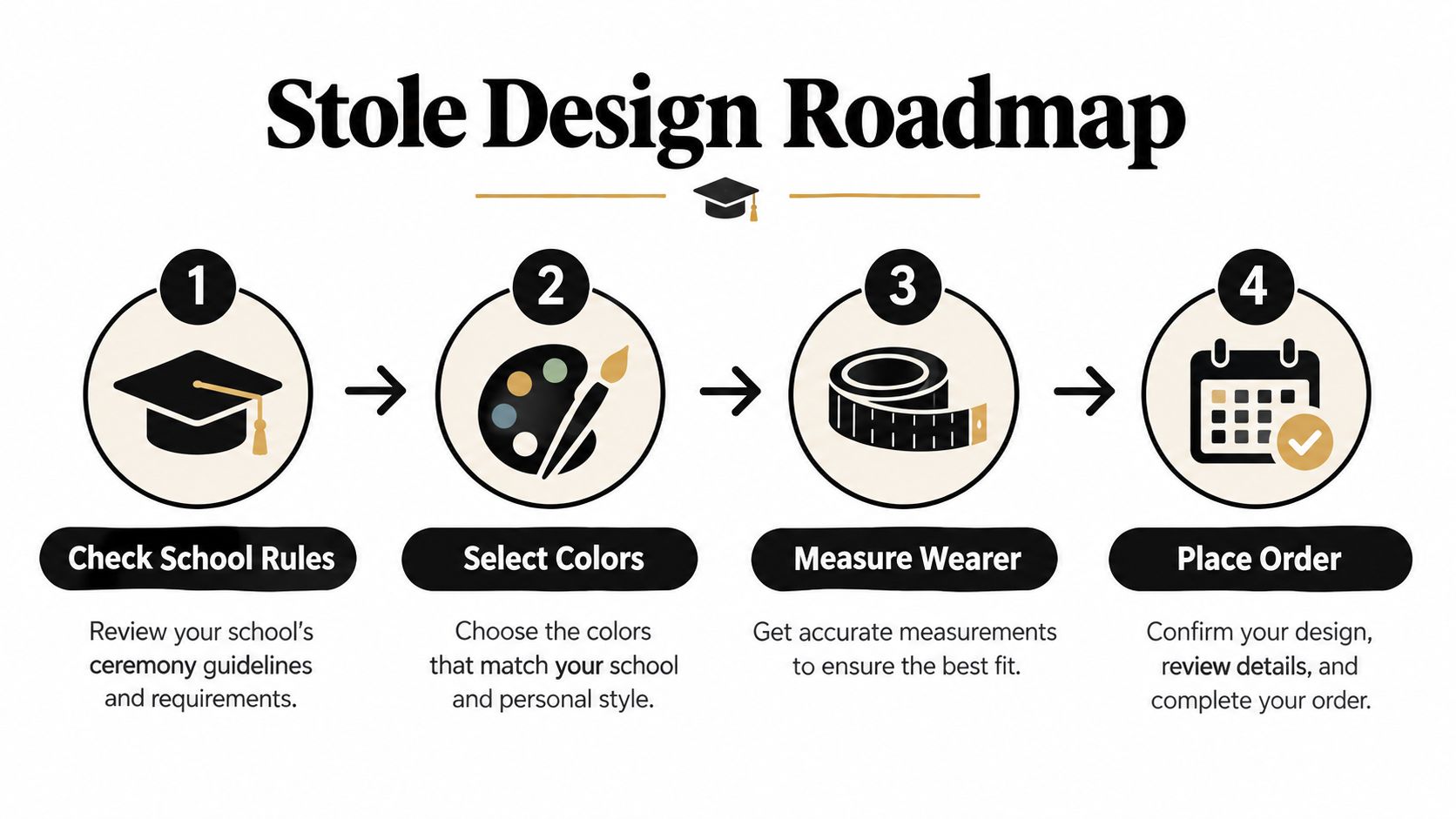
Use this roadmap to organize the decisions before committing to decoration.
Shortlist decoration methods before building the layout
Embroidery is the natural starting point for names, dates, Greek letters, and simplified insignia. Ask for a stitched sample on the intended fabric. On satin, inspect puckering and loose threads; on twill, check whether smaller letter openings remain distinct against the weave. Minimum readable text size depends on the font and production method, so obtain the decorator's limit rather than guessing.
Dye-sublimation printing is worth considering for gradients, photographs, and continuous backgrounds. Confirm fabric compatibility and inspect a printed strike-off, especially when comparing a smooth satin surface with textured twill. For a broader vocabulary when discussing decoration with a supplier, Power Print's guide to custom apparel printing methods is a useful companion.
Photo panels require another decision: a printed image or an insert, if the supplier offers one. Ask how the panel is attached, how it bends, and whether it can be cleaned with the rest of the stole. Flag panels need accurate orientation and colors; Greek letters and society insignia need authorized artwork.
An embroidered name against a restrained printed background can create a clear hierarchy. Dense Greek lettering over a photograph usually gives both elements too little breathing room. Shortlist a few approaches before opening a design tool, and ask which require sampling, artwork conversion, or extra production stages.
Materials and Finishes That Hold Up on Stage
Satin and twill describe fabric structures; polyester describes a fiber. A polyester stole can have a satin or twill construction, so a listing that says only “polyester” doesn't tell you enough about its surface or drape.
Choose by the finished sample, not the material name alone. For a photo-heavy design, I'd prioritize readable detail and controlled reflection over shine. For metallic embroidery, I'd inspect how the fabric supports the stitching before deciding which finish looks more formal.
Material comparison for custom graduation stoles
| Fabric | Drape | Light Reflection | Best For | Watch Out For |
|---|---|---|---|---|
| Satin | Evaluate how smoothly it falls over the gown | Lustrous surface; inspect under bright lighting | Formal embroidery and uncluttered designs | Visible creases, puckering, and glare across lettering |
| Polyester twill | Check stiffness and shoulder conformity | Usually a more subdued appearance | Crisp Greek letters and layouts needing a quieter background | Weave texture interfering with small photographic details |
| Matte-finish fabric | Depends on construction and lining | Designed for a less reflective appearance | Text-led layouts and busy imagery | Assuming “matte” guarantees print clarity or embroidery support |
The satin graduation stole guide is a relevant starting point when that finish is on your shortlist. Cobra DTF's guide to find the right shirt fabric can also help frame supplier questions about fiber and construction, although shirt fabric isn't a substitute for a stole sample.
Inspect the whole garment
Check lining weight, tip alignment, and edge finishing while the stole is draped over a gown. A sample that looks tidy on a table may twist or slide when worn.
For institutional purchasing, make colorfastness an acceptance criterion. AATCC textile-testing standards include TM61 accelerated laundering, which approximates five typical home or hand launderings in one 45-minute test. Test the decorated garment, inspect both color change and staining on adjacent material, and reject unacceptable dye transfer, fraying, or distorted logos rather than approving fabric by appearance alone.
Measuring for a Fit That Actually Works
Measure over the closed graduation gown, not a T-shirt. The stole needs to sit around the neckline and fall across the actual garment you'll wear, including any hood or other permitted adornments.
Don't rely on a claimed universal fit range. Ask the supplier for finished dimensions and available adjustments, then compare those with the wearer.
Record length, width, and neckline fall
- Length: Drape a flexible tape around the back of the neck and down both front panels. Record the desired endpoints and confirm how the supplier defines total length.
- Width: Use a sample stole or a paper strip to check usable panel space. Allow room for finished edges rather than treating the entire width as printable.
- V-fall depth: Note where the neckline opens and where the panels settle below the shoulders. Photograph that position with the gown closed.
The neckline fall matters because it determines where the decoration appears. A stole can have adequate total length while its upper embroidery folds inward or sits beneath other regalia.
This measuring reference can help you compare a physical garment with the dimensions on an order form.

Check the decoration where it sits on the wearer, not where it sits on the ruler.
Mark the proposed embroidered panel relative to the shoulder seam, then sit, stand, and turn for a photograph. Both ends should remain balanced without constant adjustment. For family or chapter orders, retain individual fit notes rather than assuming everyone wearing the same gown size needs the same stole.
School and Regalia Rules That Can Reject Your Order
Campus policy determines meaning. A color that represents your organization elsewhere may identify a restricted academic distinction at commencement.
Turn actual policies into approval questions
Kansas State's regalia guidelines require approval for organizational stoles and cords, with request deadlines of October 1 for fall commencement and March 1 for spring commencement. Its academic honor cords use purple and white in three styles and sizes for the Latin-honors levels.
University of the Incarnate Word's policy requires approval for all cords, stoles, and other regalia. Requests must come from faculty, administrators, or approved advisers; unapproved items aren't permitted at university-sanctioned ceremonies.
Utah State's adornment guidelines reserve solid gold, silver, and navy cords for summa cum laude, magna cum laude, and cum laude, respectively, and prohibit red for certain adornments.
USI's regalia policy requires undergraduate honors candidates to have completed, or be completing, at least 60 USI credit hours and hold a cumulative university GPA of 3.600 or higher. White cords identify its Undergraduate Honors Program; mixed red, white, and blue cords recognize military service, and other groups can't adopt those combinations.
Simmons University's commencement policy assigns blue-and-gold cords to the Academy, blue-and-white to the Honors Program, and red, silver, and gold to Latin honors. Dotson Scholars and NCAA Honor Society members receive stoles; Kotzen Scholars receive light-blue-and-dark-blue cords, and Boston Scholars dark-blue-and-red cords. It also recognizes cultural and affinity stoles while excluding university funding for their purchase.
Send a complete approval request
For younger graduates, consult the high school graduation stole requirements guide alongside the school's own policy.
Approval email: Please confirm whether the attached stole may be worn at commencement. It shows the proposed colors, dimensions, text, and insignia. Who must submit authorization, what deadline applies, and are there restrictions on logo use, placement, or accompanying cords? Please identify any required changes before production.
Contact the commencement office or registrar first; ask whether the dean of students or an adviser must participate. Save the written response with the approved artwork.
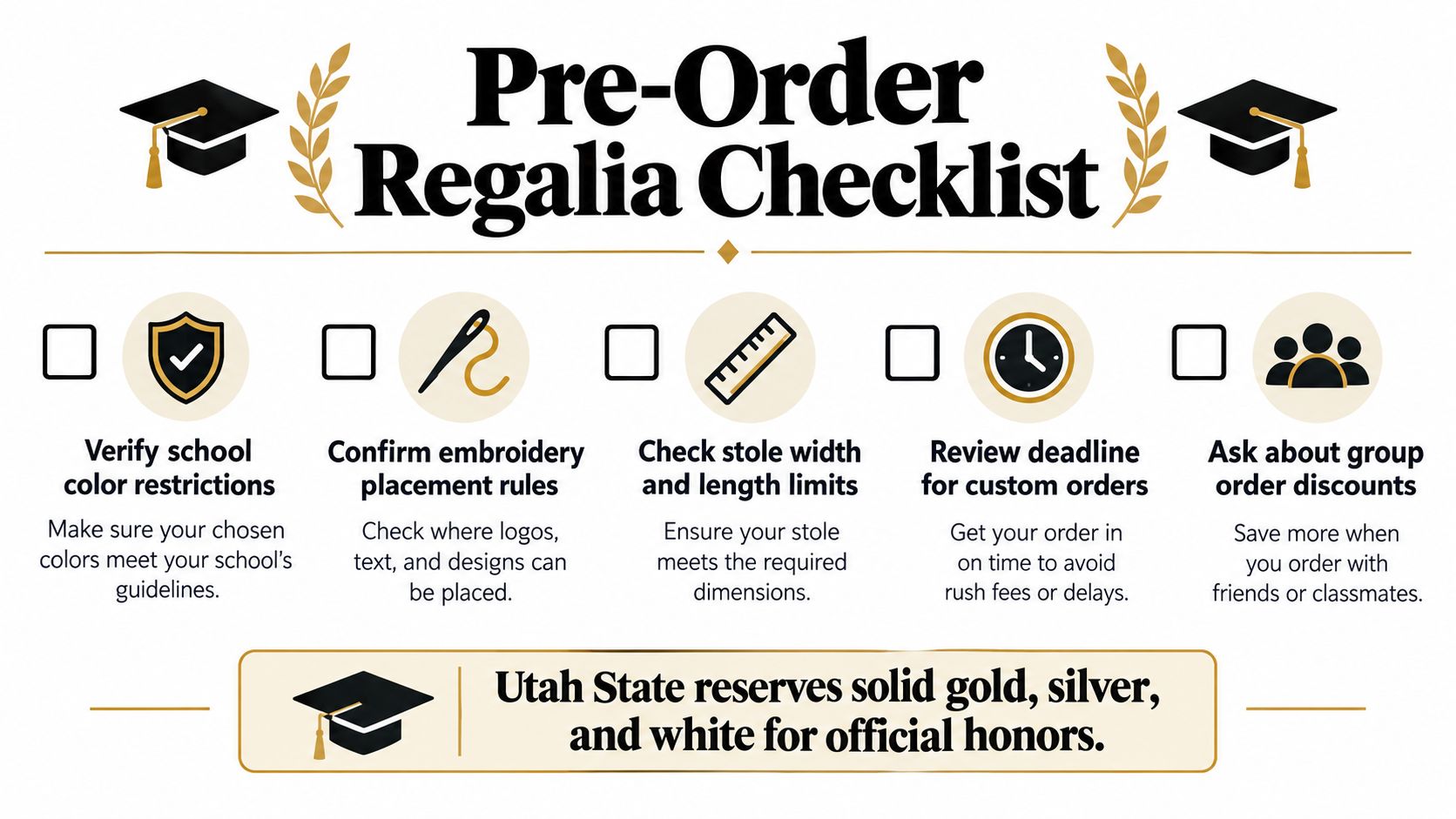
Use the checklist below, but follow the policy text above if the graphic's honors-color note differs: Utah State reserves navy, not white.
Production and Shipping Timelines That Actually Hold
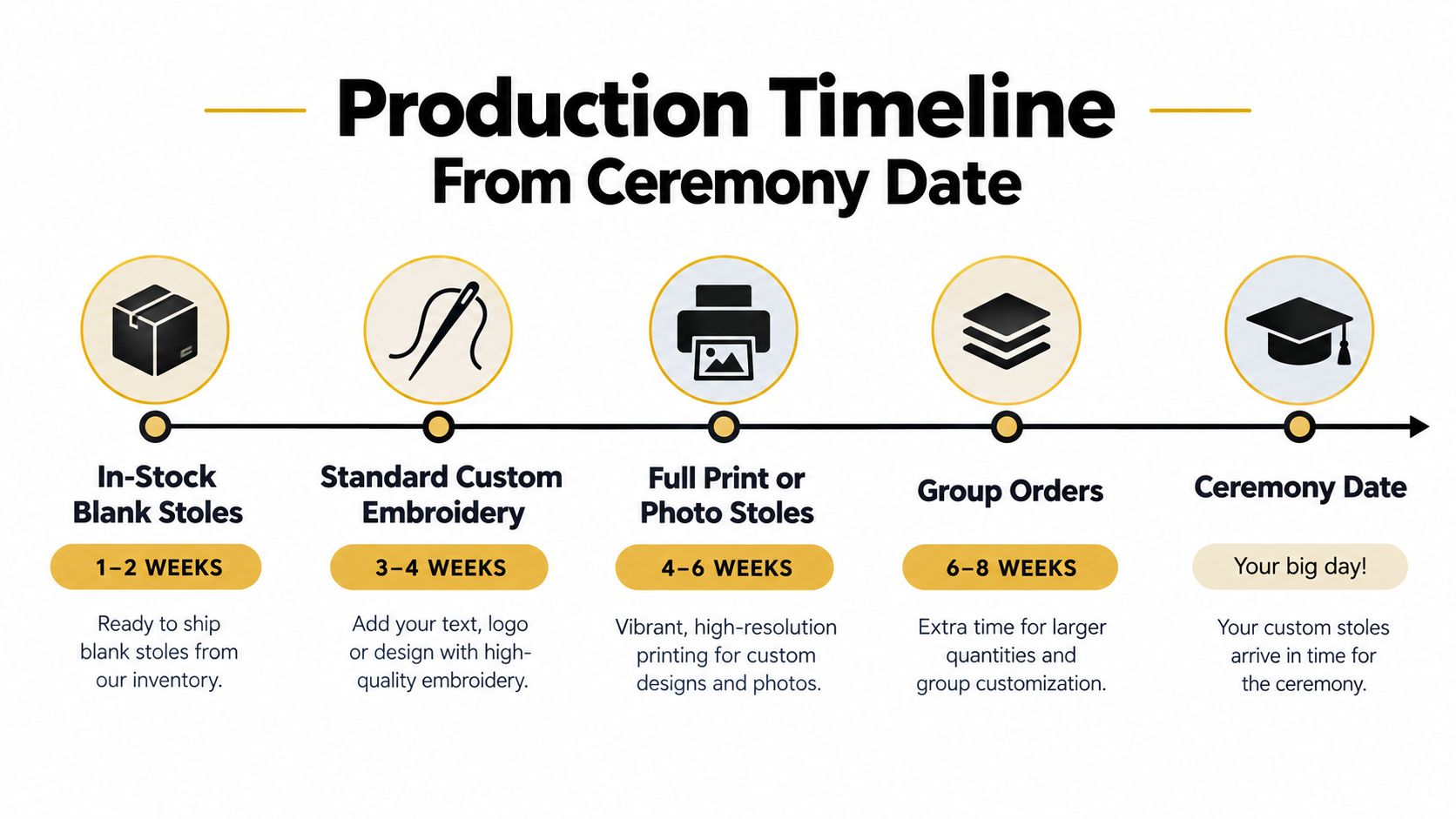
Build the calendar backward from the date you need the stole in hand, not merely the ceremony date. Leave room for a fit check and a possible replacement. Production completion, carrier collection, and delivery are different milestones.
Treat the windows shown in this planning graphic as illustrative, not confirmed supplier commitments. Ask for a written schedule for your exact order.
Work backward through the gates
| Gate | Date to enter on your calendar | Confirmation needed |
|---|---|---|
| Required arrival | Before ceremony preparation | Time for inspection and correction |
| Dispatch | Before required arrival | Carrier service and delivery address |
| Production release | Before dispatch | Approved proof and supplier schedule |
| Design lock | Before production release | Final names, symbols, colors, and dimensions |
| Institutional approval | Before design lock | Written authorization from the correct office |
In-stock blank stoles avoid personalized-artwork approval, but availability still needs confirmation. Embroidered graduation stoles require decoration preparation; full-print and photo stoles require image checks and a suitable sample. Group orders also need roster consolidation and a controlled master design.
Approve what the factory will actually make
AATCC's testing framework supports documented color and appearance evaluation. A practical production workflow uses vector artwork for names and symbols, checks stroke widths and fold clearances at finished scale, approves a sewn or printed strike-off, and compares bulk pieces against a controlled master sample.
Watch for a low-resolution image saved inside a vector-format file, incorrect Greek letters, omitted diacritics, and names changed after approval. Freeze the delivery address before shipment labels are prepared, especially if graduates are leaving campus housing.
For a visual reference alongside your written production checklist, the embedded video is available below.
Paying for faster shipping doesn't resolve unfinished artwork or an unapproved proof. Confirm which stage a rush service accelerates.
Pricing Tips and Smart Ways to Spend Less
A chapter treasurer needs a landed cost per usable stole, not just an attractive unit price. Request an itemized quote separating garments, decoration, artwork preparation, delivery, and any rush or replacement charges.
Consider a chapter collecting orders from its graduating members. The coordinator can request a consolidated quote, but shouldn't promise savings before the supplier confirms the quantity threshold and whether individually embroidered names qualify under the same pricing structure.
Compare equivalent quotes
Use this calculation with the supplier's actual figures:
Budget check: Add the garment subtotal, decoration, setup, shipping, and applicable charges. Divide that total by the number of usable stoles delivered.
Ask how pricing changes across quantity tiers. Don't assume a discount applies to every personalization combination or that a later replacement will receive the original group rate.
Clarify “single-sided” and “double-sided,” too. Suppliers may mean decoration on one front panel versus both front panels, or decoration on the front and reverse surfaces. Those aren't interchangeable specifications.
| Spending decision | Question to ask |
|---|---|
| Quantity tier | Does this roster qualify, including different names? |
| Decoration locations | Which visible panels are included in the quote? |
| Rush service | What work is accelerated, and is delivery guaranteed? |
| Replacement | What will an individual reorder cost after bulk production? |
Reduce complexity without weakening the garment
- Consolidate early: Close the roster before requesting the final quote so late additions don't become separate orders.
- Decorate visible areas: Skip reverse-side work if it won't serve the ceremony or keepsake purpose.
- Ask about chapter pricing: Compare the complete group quote with equivalent individual orders, including delivery.
The guide to cheap custom graduation stoles is useful when comparing budget choices. Keep the approved fabric and finish fixed while testing simpler decoration layouts; otherwise, you won't know whether the savings came from design efficiency or a different garment.
Confirm who pays before collecting money. A school, chapter, family, or student-funded purchase may need different authorization, reimbursement, and replacement arrangements.
Ceremony Etiquette, Care, and Wearing the Stole Right
Put the complete outfit on before commencement morning. Close the gown, arrange the hood according to your institution's directions, and add only the approved graduation sash and honor cords. Check the view from the front, side, and seated position.
There isn't a universal shoulder assignment for Greek letters that you should impose without checking. Use your organization's convention, the approved proof, and campus instructions. When discussing left and right placement with a decorator, specify whether you mean the wearer's perspective or the viewer's.
Make recognition readable without crowding it
Stoles and cords aren't interchangeable honors. A stole can identify affiliation, while cords may carry a separately authorized distinction. Don't add a "summa cum laude stole" because the phrase suits the design; the recognition must match the institution's rules and your eligibility.
If multiple stoles are permitted, arrange them so meaningful symbols remain visible without covering the hood or creating a bulky neckline. Ask the ceremony team how to handle competing pieces rather than improvising in the procession line.
Cultural representation deserves a different kind of review. In 2025, the University of New Brunswick introduced Indigenous and African/African-diasporic graduation stoles designed by artists rooted in the represented communities. That example supports a practical approach: consult the people represented by a design before treating it as a decorative template.
- Consult community members: Ask cultural organizations about appropriate symbols and how designs should be used.
- Credit the artist: Obtain permission and preserve attribution where applicable.
- Distinguish nationality from heritage: An international flag stole may express country affiliation without fully expressing Indigenous identity, diaspora, regional tradition, or mixed heritage.
- Confirm access and funding: Establish who can purchase or receive the garment and who pays.
Kente, LGBTQIA+, Indigenous, and other affinity stoles shouldn't be treated as interchangeable patterns. If cultural attire is permitted but organizational branding is restricted, ask about that distinction explicitly.
Care for the finished decoration
Follow the supplier's instructions for the decorated stole, not generic advice for blank satin. Thread, metallic details, printed panels, adhesives, and inserts may require different handling.
If pressing is permitted, test an inconspicuous area and use the specified temperature and protective barrier. Don't assume steam is safe for every print or attachment. Avoid applying heat directly to decoration unless the care instructions expressly allow it.
Store the stole clean and dry, flat where practical, without sharp folds through embroidered or printed panels. After the ceremony, inspect it for marks before putting it away. For coordinating family pictures, EventUploader's graduation photo collection ideas can help you plan how everyone will share their images.
Keep the execution checklist on your phone
- Confirm: School rules, eligibility, logo permissions, and the approval owner.
- Choose: Decoration approach, fabric, and wearer-specific dimensions.
- Lock: Final artwork, roster, delivery address, and budget.
- Order: Use the confirmed production schedule and approve the physical sample when needed.
- Inspect: Compare the delivery with the approved master and report discrepancies promptly.
- Prepare: Fit-check the complete outfit, follow care directions, and store it safely.
- Wear: Follow the ceremony team's arrangement instructions and keep the panels readable.
The stole's symbolic role extends beyond decoration. Academic stole traditions connect the garment with organizational membership, achievement, cultural identity, and program affiliation. Academic dress itself has medieval European roots, while the stole generally sits outside the formal American Council on Education costume code.
That distinction leaves room for personal expression, but not automatic permission. The finished garment should make your story visible while respecting the ceremony you're entering.
Stoles.com® offers customizable graduation stoles, international flag stoles, Greek-letter stoles, honor stoles, and honor cords for individual graduates and organizations. Bring your approved colors, measurements, artwork, and required arrival date to Stoles.com® to explore a graduation stole that represents your achievement and fits your ceremony's requirements.