

You're standing in front of the mirror with your cap on, your gown zipped, and an AKA graduation stole draped over one shoulder. You adjust the green and pink fabric, turn sideways to check the embroidery, and wonder whether your university allows it, whether the length will look right, and whether you should add your name, chapter, or graduation year. A parent or family member may have a different question: what does the stole represent?
An AKA graduation stole can mark a personal milestone while publicly identifying membership in Alpha Kappa Alpha Sorority, Incorporated. It may also express cultural identity, sisterhood, leadership, and pride in the work that brought you to commencement. The meaning matters, but so do the practical details. Fabric, sizing, customization, production time, and campus rules all deserve attention before ceremony day.
What an AKA Graduation Stole Represents Today

A stole is a decorative sash worn over the academic gown. In an AKA version, the pink-and-green color palette and Greek-letter embroidery create a visual signal that can communicate sorority affiliation, achievement, and identity at a glance. Your family may see a beautiful accessory. Your line sisters may recognize a shared tradition. Your university may classify it as personal adornment rather than official academic regalia.
That distinction helps explain why an AKA stole receives attention but doesn't function exactly like every other piece of commencement dress.
How the pieces differ
The plain gown provides the base layer for the ceremony. The academic hood generally connects to a degree level or field of study, according to the institution's regalia system. Honor cords more often identify academic distinction, while a sorority stole identifies an organization, community, or personal affiliation. Other sashes may represent cultural groups, student leadership programs, athletic teams, or degree-college membership.
Schools often assign their own meanings to colors and accessories. The University of South Carolina, for example, uses a braided garnet, black, and white cord for Graduation with Leadership Distinction, while UWM identifies a pewter stole for Honors Degree recipients and a black-and-gold stole for McNair Scholars. Those examples show why a visual accessory can carry an institutional message, not just a decorative one. University of South Carolina's academic regalia guidance illustrates how cords and stoles can be assigned to specific categories.
Practical rule: Treat the stole as meaningful clothing with ceremony rules, not as a substitute for your official academic hood or honor cord.
Before you order, check whether your school restricts colors, length, logos, or embellishments. If you're also exploring chapter apparel for life after commencement, a guide to custom Greek apparel can help you think through coordinated lettering, colors, and personalization. The right AKA stole should honor your sisterhood while fitting comfortably within the ceremony's expectations.
The History Behind the AKA Sorority Stole
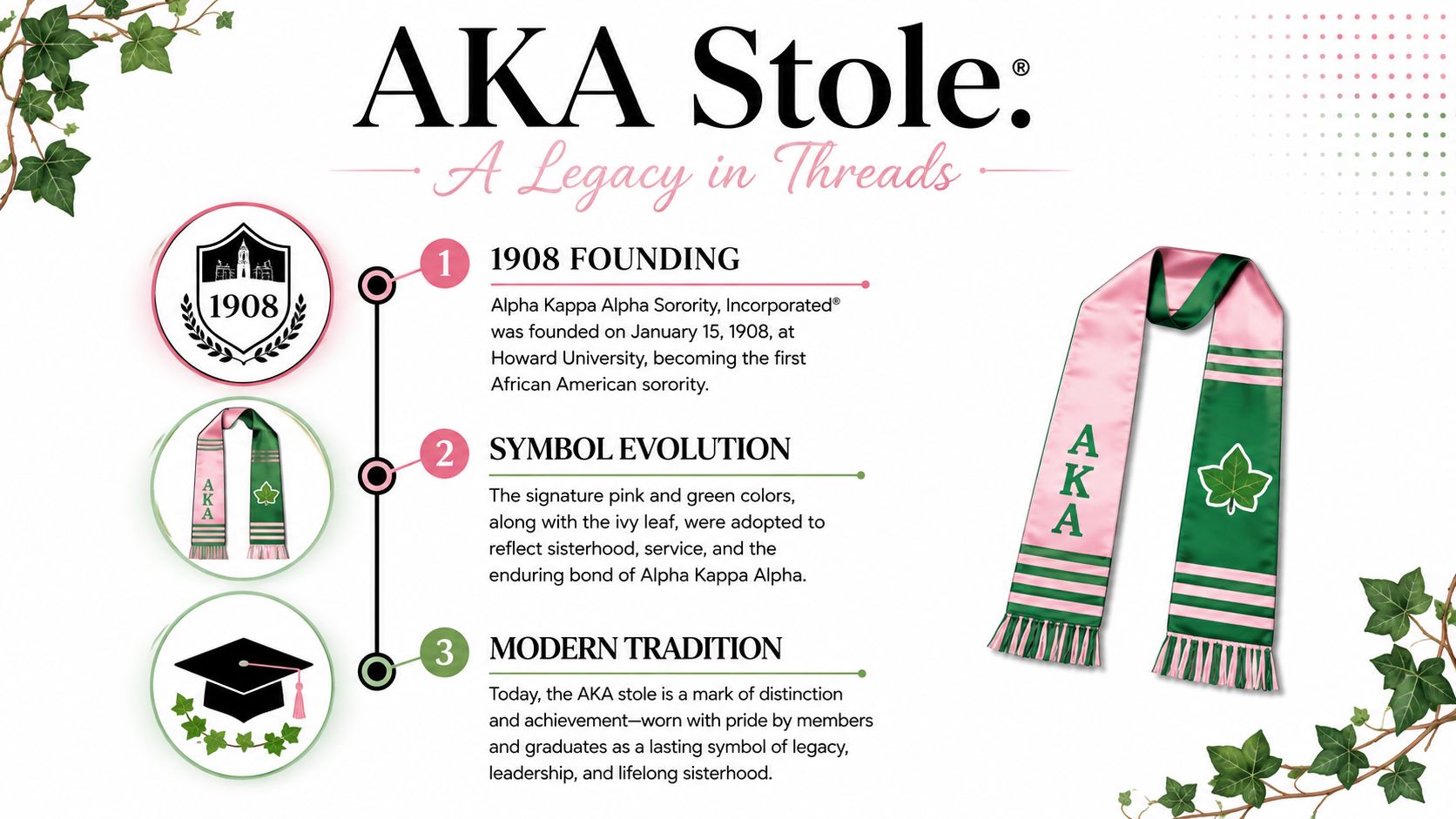
Alpha Kappa Alpha Sorority, Incorporated was founded at Howard University in 1908 as the first Greek-letter sorority established by African American women. That origin gives the modern AKA graduation stole a meaning that reaches beyond a single campus ceremony. The garment connects a graduate's academic milestone to a longstanding tradition of Black women building community, pursuing education, and representing excellence publicly.
The symbols associated with the sorority helped shape the visual language that appears on contemporary stoles. Pink and green, ivy imagery, and pearls are recognizable elements of AKA identity. On a stole, these details work much like a family crest. They help viewers identify the community represented without requiring an explanation printed across the fabric.
From sorority symbols to commencement dress
The stole tradition developed alongside broader academic regalia customs. Academic dress traces back almost 1,000 years, with roots in 12th- and 13th-century European universities, where scholars wore long garments influenced by Catholic and Anglican clergy. In the United States, the modern system became more standardized after the 1895 creation of the Intercollegiate Code of Academic Costume, which formalized the use of gowns, hoods, and colors. The history of graduation stoles and sashes explains how that milestone turned varied customs into a more recognizable academic language.
By 1960, nearly 95% of U.S. postsecondary institutions followed the accepted academic dress system, according to the same historical source. As standardized regalia became familiar, stoles could serve as flexible display surfaces for identity, affiliation, honors, and cultural belonging.
Other Divine Nine organizations later adopted comparable graduation stoles, but AKA's combination of pink, green, ivy, pearls, and Greek letters remains distinctive. The garment is therefore more than an accessory added at checkout. It carries a century of institutional and cultural weight, so wearing one is a deliberate choice.
Decoding AKA Stole Colors and Symbols
Start with the color pairing. Salmon pink and apple green are the official AKA colors, and manufacturers may arrange them in alternating panels, contrasting trim, borders, or layered sections. Think of the combination as a school crest or family crest. You don't need to memorize every design variation to understand the central signal: the colors identify the sorority's visual tradition.
The color meanings are often explained through ideas such as vitality, femininity, and growth. The exact arrangement can vary by product or chapter, so don't assume that a single online color chart defines every acceptable design. Broader graduation guidance also shows that stole colors can carry recurring associations with fields of study and achievement, but those meanings aren't universal. This guide to graduation stole colors and meanings is useful for comparison, especially if you're deciding whether an AKA stole should appear alongside an honor stole or cord.
What the symbols communicate
- The ivy leaf connects to the ivy bushes near Howard's Miner Hall, where the founders met. In modern use, it suggests endurance, continuity, and sisterhood.
- Pearls evoke refinement, maturity, and the value of a woman's development through education and service.
- Twenty pearls appear in some AKA representations and can be included as a specific design element on a stole. If your chapter has an approved interpretation or preferred layout, follow that guidance rather than relying on a generic seller description.
- Alpha Kappa Alpha Greek letters make the affiliation unmistakable. They tell viewers that the stole represents membership, not a pink-and-green fashion choice.
The best purchase begins with a short design list. Write down the symbols you want, the lettering you prefer, whether your chapter name belongs on the back, and whether a personal name or year should appear. That list keeps customization focused and helps you compare a Greek stole with other graduation stole colors and meanings without flattening AKA symbolism into a generic chart.
Customization Options for AKA Stoles
Customization works best when you make decisions in a fixed order. Begin with the base fabric and color layout, then move to lettering, then add personal details. That sequence prevents a common problem, where a buyer chooses attractive embroidery first and discovers later that the text doesn't contrast with the stole.
Choose the visual foundation
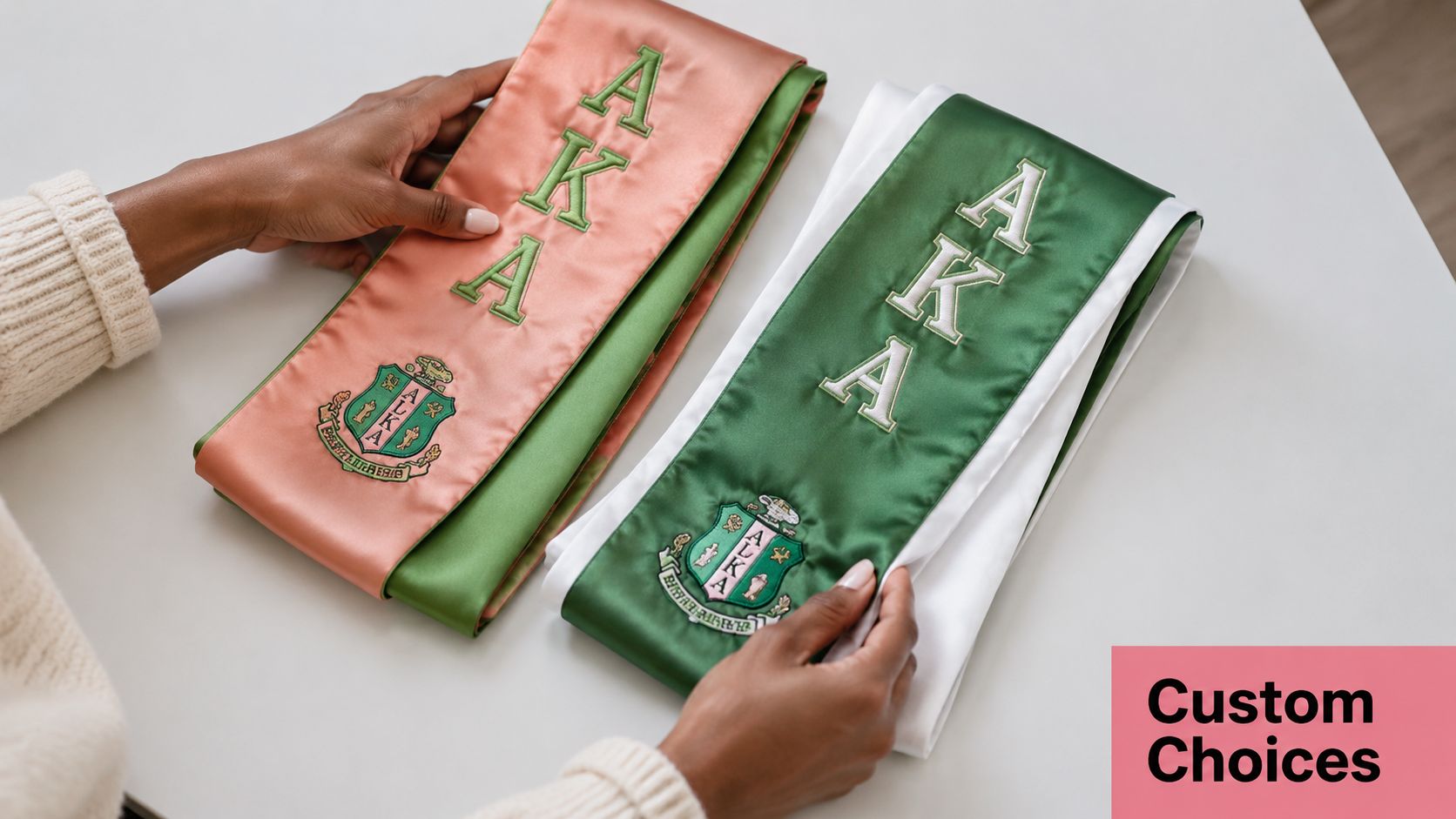
A traditional starting point is salmon pink and apple green. Some chapters may prefer a design that incorporates an ivy leaf or pearl-white elements. Confirm any chapter-specific expectations before selecting a layout, especially if several members are ordering together.
Then choose the Greek lettering style. Block lettering reads clearly from a distance, Old English adds a formal collegiate feel, and script can look softer but may lose clarity when the letters are small. Stitch color should contrast with the base. Metallic gold has a classic appearance under stage lights, while matte thread often photographs with cleaner edges.
Add personalization carefully
A practical arrangement might include:
- Name placement: Put the graduate's name on one side, with enough space from the hem for the letters to remain visible.
- Year placement: Put the graduation year on the opposite side, facing outward rather than underneath the gown.
- Back design: Use the back for chapter identification, Greek letters, or a coordinated phrase approved by the group.
- Additional details: Add line information, an honor designation, or a graduate-school identifier only when the space and campus rules support it.
High embroidery density generally withstands handling better than sparse stitching, but dense designs can feel heavier and cost more. Always request a digital proof before approval. Check every letter, apostrophe, spacing choice, and location. A name spelled incorrectly on a beautiful stole is still incorrect, and a rush reprint may not arrive before the ceremony.
You'll find more examples of lettering layouts and design decisions in this guide to customizing a Greek stole.
A short video can also help you visualize how a custom Greek stole comes together before you finalize the design.
Materials and Sizing That Actually Fit
Fabric changes the way an AKA graduation stole hangs, catches light, photographs, and survives storage. The prettiest option on a product page isn't automatically the best choice for a long ceremony or repeated alumnae events.
| Material | What it does well | What to watch for |
|---|---|---|
| Satin | Creates a smooth, glossy surface that photographs beautifully | Can snag more easily and may show handling marks |
| Polyester twill | Offers a durable, practical finish with better wrinkle resistance | Has a less reflective appearance than satin |
| Silk-blend | Feels premium and drapes elegantly | Costs more and needs careful steaming and storage |
A single-layer stole feels lighter and tends to sit easily over a gown. A double-lined version has more body and appears more opaque against a black gown, but it can feel warmer under stage lights. Your decision should reflect both ceremony comfort and how often you expect to use or display the stole afterward.
Measure for the drape
Common stole lengths run from 72 to 84 inches, with widths between 4 and 6 inches. Those dimensions should be checked against the seller's size chart and your own height, because a standard label doesn't guarantee the same visual result across every cut.
A taller student should size up rather than accept a stole that barely reaches the desired position. A stole that is too short may ride upward, hide the lower embroidery, or look uneven in photographs. Try the measurement over a gown or a similar layer, not over a thin shirt.
Simple decision rule: Choose satin for visual shine, polyester twill for everyday durability and easier handling, and a silk-blend when the premium drape justifies extra care.
Ordering Timeline and Production Schedule
Work backward from commencement instead of ordering when the ceremony starts to feel real. Custom embroidery typically takes 2 to 4 weeks after artwork approval, followed by domestic shipping that may take 3 to 7 business days, according to the graduation stole ordering guide. International delivery and rush requests require additional planning.
A safer target is to place the order at least 6 to 8 weeks before commencement. That window leaves room for proof revisions, an unexpected supply issue, or a correction if a name or chapter detail is entered incorrectly. Artwork approval matters because production timing generally begins after the design is confirmed, not when you first place an inquiry.

Use a backward checklist
- Eight weeks out: Confirm your university's stole policy, choose the material, and place the order.
- Six weeks out: Review the proof carefully and approve the artwork only after checking names, Greek letters, colors, and placement.
- Four weeks out: Expect production to be underway after approval. Ask the seller whether any missing information is holding the order.
- One week out: Open the package, inspect the embroidery, test the drape over your gown, and contact the seller immediately if something is wrong.
Late orders still have possible paths, but each involves tradeoffs. Expedited production may cost more, a blank stole can be hand-finished by a local embroidery shop, and rush shipping doesn't remove production time. Peak commencement periods in May and December can also make timing less predictable, so ask for a delivery commitment rather than assuming a shipping upgrade guarantees arrival.
Wearing the Stole at Commencement
Put the stole over your shoulders and allow both panels to hang evenly down the front. The AKA Greek letters, personal name, and graduation year should face outward and read right-side up. Before leaving for the ceremony, stand in front of a mirror while wearing the full cap and gown, then check whether the hood, cords, and stole overlap in a way that hides important embroidery.
The cleanest drape starts with a smooth layer underneath. Bulky scarves, hooded sweatshirts, and high-collared tops can distort the V-shape or push the stole toward your neck. A simple, low-profile garment usually lets the sash lie flat and keeps the visual focus on the embroidered design.

Check the campus rules
Universities often distinguish a sorority stole from official academic honors. Honor cords may be issued by a registrar or academic department under formal GPA or program rules, while a sorority stole may be treated as personal adornment. That doesn't mean every design is automatically allowed.
Georgia Tech reserves undergraduate honor cords for academic honors based on GPA at the start of the graduating semester. Its policy permits other cord designations only with specific permission through the Registrar and the Office of the Provost, and it identifies white for honors, gold for high honors, and white-and-gold braided cords for highest honors. Georgia Tech's commencement regalia policy shows how tightly a university can control cord use.
The University of Memphis limits stoles to Registered Student Organizations, university-recognized honor societies, and university athletic teams. Its policy assigns white cords to distinction, red or crimson cords to high distinction, and gold cords to highest distinction. The University of Memphis stole and cord policy is another reminder that campus rules vary.
Ask the registrar, commencement office, or student affairs office about length, colors, logos, embellishments, and placement before ordering. Your chapter may have its own approval process as well.
Care and Storage After Graduation Day
Your stole may leave the stage, but it doesn't have to leave your life. Care for it as both a textile and a record of your achievement. Small marks can often be treated with gentle spot cleaning and a mild detergent, while heavier soiling may call for hand washing in cool water, provided the manufacturer's care label allows it.
Avoid wringing the fabric, machine drying it, or ironing directly over embroidered threads. If pressing becomes necessary, use a low-heat setting with a press cloth between the iron and the stole. Satin can lose its smooth appearance under excessive heat, while dense stitching can flatten or distort when pressed directly.
Store the symbols with intention
After the stole is completely dry, fold it with acid-free tissue between sections to reduce creasing and color transfer. Place it in a breathable garment bag, then store it away from direct sunlight. This protects the salmon-pink and apple-green hues from fading and keeps the Greek lettering easier to read when you bring the stole out for an alumnae gathering, anniversary, or family display.
Don't store it in a sealed plastic bag while moisture remains. Don't place heavy objects on top of the embroidery. A little preparation now protects the fabric, the lettering, and the visual balance you approved before production.
The care routine reflects the meaning of the garment. The ivy suggests endurance, the pearls suggest refinement, and the colors connect your achievement to a sisterhood with a long history. Preserving the stole lets it remain more than a commencement accessory. It becomes a tangible reminder of the work, relationships, and identity you carried across the stage.
Stoles.com® offers customizable graduation stoles, Greek-letter stoles, honor stoles, graduation honor cords, and other ceremonial designs for students and organizations. Visit Stoles.com® to compare AKA-inspired customization options, review personalization choices, and select a stole that fits your ceremony rules and your story.